
The Three Technician Metrics
Productivity, efficiency, and recovery each measure something different, and reading any one alone gives a false picture — the fast tech who sits idle and the busy tech who’s slow look identical on a single number and are opposite problems. Together the three read what’s actually happening in the bay.
What each measures
Productivity is billed hours against available hours — is the tech actually working billable jobs, or idle between them. Efficiency (proficiency) is billed hours against actual hours taken — how the tech’s speed compares to the flat-rate standard, so 100% is on pace, above is faster than standard, below is slower. Recovery is how much of the labor and shop cost the billed work recovers. Different levers move each, so you have to know which number is the problem.
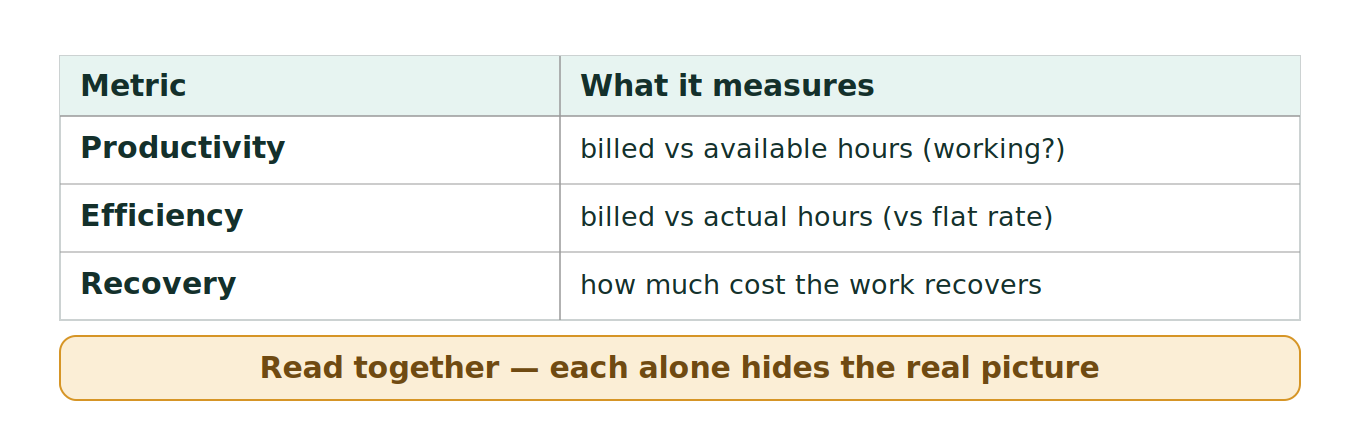
Read them together
The combinations tell the story. High efficiency but low productivity is a fast tech sitting idle between jobs — a dispatch and workflow problem, not a tech problem, and the biggest hidden leak in most shops. Low efficiency but high productivity is a busy tech who’s slow — a skill or job-match problem, coachable through training or better dispatch. High on both is a strong, well-fed tech. Chasing the wrong number — pushing a fast-but-idle tech to work faster — fixes nothing, because the problem was the empty bay, not the wrench speed.
Fix the right lever
Idle-between-jobs is solved by staging parts, readying the next job, and clearing approvals — the workflow around the tech. Slow-on-the-job is solved by training, tooling, and matching jobs to skill. Reading all three keeps a manager from coaching a workflow problem as if it were a performance problem, or vice versa.
Where it goes wrong
- Reading one metric alone and misdiagnosing the problem.
- Pushing a fast-but-idle tech to work faster instead of fixing the empty bay.
- Coaching a workflow problem as a performance problem.
- Ignoring the dispatch and parts-staging leaks that tank productivity.
Related
Dispatching technicians · Service financials and labor margin · Reading the scoreboard · Reducing comebacks.