
Reducing Comebacks and Improving Quality
A comeback is a job done twice — free the second time, plus a customer who now doubts the shop. It’s one of the most expensive things a shop produces, and the fast-but-wrong technician who generates comebacks costs more than a careful one who’s a little slower.
The comeback costs more than the redo
When a machine comes back for the same problem, the shop eats the second repair (no billing a customer twice for one fix), the bay is occupied by rework instead of new revenue, and — the expensive part — the customer’s trust takes a hit that the original job’s speed didn’t buy back. A tech measured only on speed who leaves a trail of comebacks is a false economy; the true cost of the work includes the ones that come back.
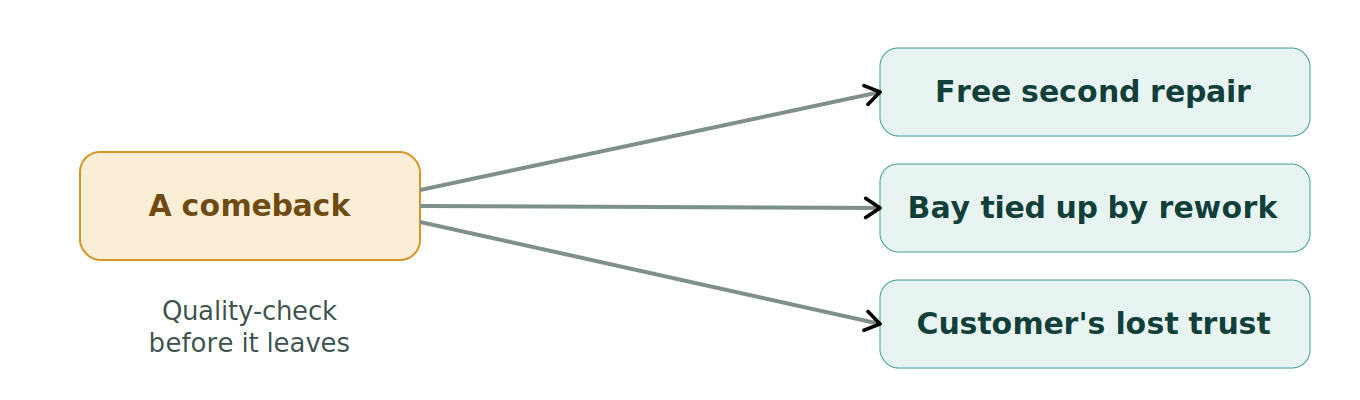
Quality-check before it leaves
The cheapest comeback is the one caught before the machine leaves the shop — a final quality check that confirms the complaint is actually fixed, nothing else was disturbed, and the work is right. Verifying the repair (test it, confirm the code’s gone, confirm the function works) costs minutes; the comeback it prevents costs a redo and a customer. Skipping the QC to push the machine out the door is how a shop trades a few minutes now for a job done twice later.
Root-cause the comebacks
Comebacks aren’t random — they trace to causes: rushed work, a skipped step, a misdiagnosis (fixing the code instead of the cause), the wrong part, or a job beyond the tech’s skill. Tracking why jobs come back and fixing the cause — better dispatch, training, verification, diagnosis discipline — reduces them systematically, where blaming the tech for each one doesn’t. A rising comeback rate is a process signal, not just a bad-luck streak.
Where it goes wrong
- Measuring techs on speed alone and rewarding fast-but-wrong.
- Pushing machines out without a final quality check.
- Fixing the code instead of the actual cause and inviting the comeback.
- Not tracking why jobs come back and treating each as a one-off.
Related
The three tech metrics · Diagnostics and reading fault codes · Advanced and intermittent diagnostics · Quality culture.