
Whole-Dealership Financial Management
Running the whole dealership’s finances is a different job than running one department’s P&L — it’s balancing the departments against each other, managing cash and the balance sheet, and steering the whole business on the numbers that matter most. The mindset shifts from optimizing a piece to optimizing the system.
The departments are one system
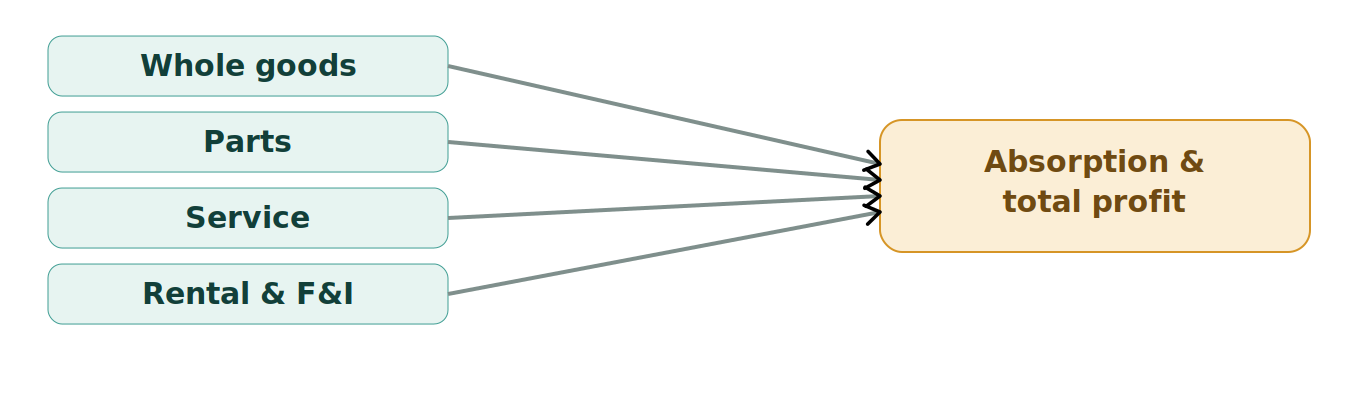
A dealership makes money as a system, not as independent silos: thin whole-goods gross is carried by parts and service margin (absorption), the sales that move iron feed the parts and service work for years, rental feeds used inventory and sales leads. Managing the whole business means seeing those connections — a decision that helps one department at another’s expense, or a department optimized in isolation, can hurt the system. The headline read is absorption (fixed operations covering overhead so whole-goods gross is profit), and steering the whole dealership means managing the departments toward the system’s health, not just each one’s own number.
Cash and the balance sheet, not just profit
Department managers watch their P&L; running the dealership means also managing cash and the balance sheet — the inventory (the largest asset) and the floor plan against it, receivables, working capital, and whether the business is financially sound, not just profitable this month. A dealership can show a profit and still be starved for cash if inventory is bloated and receivables are aging; it can be sound one year and fragile the next. Managing the whole business means watching liquidity and the balance sheet alongside the income statement, because a business runs on cash and can be sunk by a strong-looking P&L hiding a weak balance sheet.
Steer on the vital numbers
The owner or GM can’t manage every line, so the job is watching the few numbers that steer the whole business — absorption, total gross and net, cash and working capital, inventory levels and aging, the OEM scorecard (market share, CSI) — and driving the departments toward them. Reading these against budget, trend, and benchmark, and adjusting, is running the dealership on reality. It ties every department’s work to the whole business’s health, which is exactly the perspective a department head has to grow into to run the place.
Where it goes wrong
- Managing departments as silos instead of one system.
- Watching profit while cash and the balance sheet drift.
- Letting inventory bloat or receivables age until cash is tight.
- Not steering on the few whole-business numbers that matter.
Related
How a dealership makes money · Reading and managing your department’s P&L · Inventory and working-capital strategy · Strategic and business planning.