
Buying and Selling Dealerships (Valuation Basics)
Dealerships get bought and sold — consolidation is reshaping the industry — and understanding roughly how one is valued matters whether you’re buying, selling, planning succession, or just working at a store that might change hands. The value isn’t one number; it’s the sum of the pieces plus what the business earns, and the OEM has a say in who ends up owning it.
What a dealership is worth
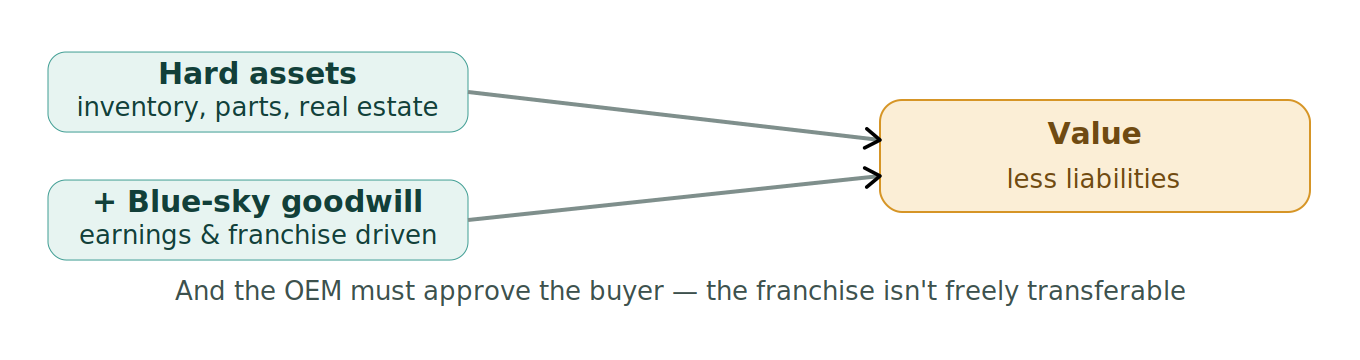
A dealership’s value is built from a few components: the hard assets (inventory valued realistically, parts, equipment, real estate if owned), the blue-sky / goodwill (a premium for the going concern — the franchise, the customer base, the earnings power, typically tied to the profitability and the brand’s desirability), and adjustments for the liabilities and the quality of what’s there. A profitable dealership with a strong franchise, clean inventory, good market share, and a solid team commands a real goodwill premium; a marginal one with aged inventory and weak performance is worth closer to its adjusted asset value. The earnings the business actually produces drive the blue-sky, which is why the financials and benchmarks matter so much to value.
Clean books and real numbers drive value
What a buyer pays turns on the quality and believability of the numbers, which is where all the earlier discipline pays off: accurate financials, realistically valued inventory (not aged units carried at full value), clean floor-plan reconciliation, documented deals, healthy absorption and benchmarks. A dealership with clean, trustworthy books and strong metrics sells for more and more smoothly; one with messy records, hidden aged inventory, and murky numbers gets discounted or scares buyers off. Both buying and selling well depend on doing the diligence — a buyer verifies the numbers behind the price, and a seller who kept clean books commands the value.
The OEM controls the franchise transfer
A crucial wrinkle specific to this industry: the franchise isn’t freely transferable. The manufacturer must approve the new owner, and can have rights around transfers and even the ability to influence or block a sale to a party it doesn’t want. So a dealership sale is really two deals — the business transaction between buyer and seller, and the OEM’s approval of the buyer as a dealer — and neither works without the other. Anyone buying, selling, or planning succession has to factor the OEM’s role from the start. These transactions are complex and high-stakes, squarely the province of qualified legal, financial, and valuation advisors.
Where it goes wrong
- Treating value as one number instead of assets plus earnings-driven goodwill.
- Messy books and hidden aged inventory that discount the value or scare buyers.
- Ignoring the OEM’s control over the franchise transfer.
- Improvising a complex transaction without qualified advisors.
Related
Succession and exit planning · Managing the OEM relationship · Whole-dealership financial management · Industry trends (consolidation).
(General information, not legal, tax, or financial advice; consult qualified advisors.)