
Pay Plans and Incentives by Department
A pay plan is the most powerful behavior-shaping tool in the dealership — people do what they’re paid to do — so a plan aligned with the right outcomes drives the business, and a misaligned one drives the wrong behavior no amount of coaching will fix. Each department’s plan reflects what that role should optimize.
Pay drives behavior
Whatever a pay plan rewards is what people will maximize, which makes plan design a management decision with outsized consequences. A commission plan paid purely on volume drives volume — including deals that don’t make money; a plan paid on gross drives profitable deals; a plan ignoring CSI can produce sales that burn customers. The lesson is that incentives shape behavior more reliably than exhortation, so the plan has to reward the actual outcomes you want, because you’ll get exactly what you pay for. A misaligned plan quietly drives the wrong behavior every day while management wonders why coaching isn’t working.
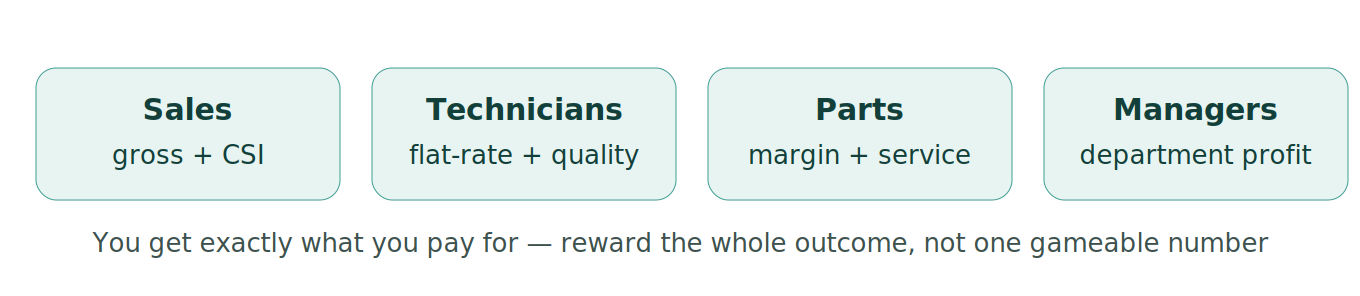
The department pay structures
Each department’s plan reflects what it should optimize. Sales typically runs on commission tied to gross (not just volume), often with CSI and F&I components, plus draws and spiffs. Technicians commonly run on flat-rate or efficiency-based pay that rewards productivity — with quality guardrails, because a plan paying pure speed invites comebacks. Parts blends base with incentives on sales, margin, and service. Managers are tied to their department’s profitability and key metrics. Support and office roles are usually salaried or hourly with appropriate incentives. The through-line: each plan should reward the balanced outcome the role owns, not a single number that can be gamed at the business’s expense.
Design for the whole outcome
The best plans reward the complete right behavior, not one metric that games easily — sales on gross and CSI (so profitable deals and happy customers), techs on productivity and quality (so fast and right), parts on sales and margin (so volume and profit). A plan that rewards one number in isolation gets that number optimized and everything else sacrificed. Plans also have to be clear (people can calculate their pay and see the connection to their work), fair, and competitive enough to retain scarce talent. And they must be administered accurately — a pay plan people don’t trust to be calculated right, or that changes arbitrarily, breeds resentment fast.
Where it goes wrong
- Rewarding a single number that gets gamed at the business’s expense.
- Paying volume without gross, or speed without quality.
- Plans so complex people can’t see how their work drives their pay.
- Administering pay inaccurately or changing plans arbitrarily.
Related
Payroll basics · The three tech metrics · How a dealership makes money · Retention, comp, and benefits.
(General information, not legal or compensation advice; follow your dealership’s plans and current law.)