
Teamwork Across Departments
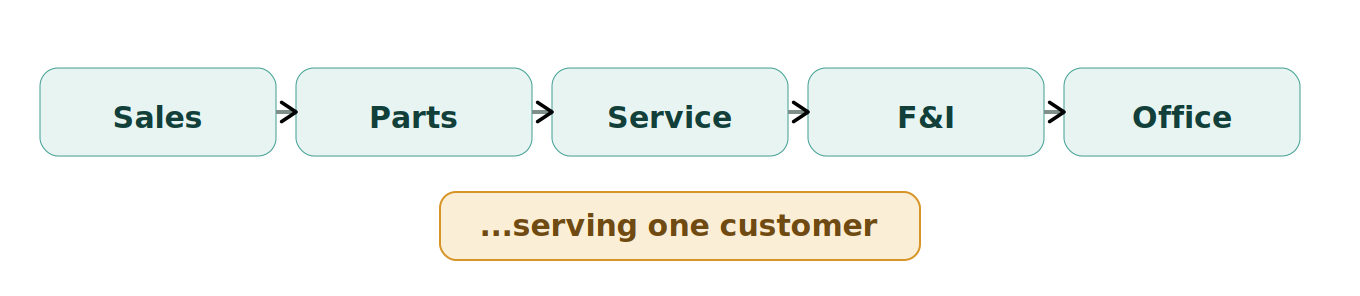
A dealership only works when the departments work together — sales, parts, and service are links in one chain serving the same customer, and the handoffs between them are where the customer experience is made or broken. Silos and turf wars feel internal but the customer pays for them.
The departments are one chain
No department serves the customer alone: sales delivers a machine that parts and service will support for a decade; a service job needs parts staged and the writer’s clean write-up; a deal needs sales, F&I, and the office to hand off cleanly. The customer doesn’t see departments — they see one dealership — and their experience is only as good as the handoffs between the people serving them. When departments cooperate, the customer gets a seamless experience; when they don’t, the customer falls into the gaps (“that’s parts’ problem,” “sales never told us”) and blames the whole dealership. Teamwork across departments isn’t corporate nicety; it’s what makes the customer experience whole.
Silos and turf wars cost the customer
The natural pull is toward silos — each department optimizing its own numbers, protecting its turf, blaming the others when something goes wrong. That inward focus quietly hurts the customer and the whole dealership: the sale that helps sales’ number but hands service a poorly-configured machine, the departments that don’t communicate a customer’s issue, the turf war that leaves a customer bounced between counters. A department can hit its own metrics while degrading the system, which is why the whole-dealership perspective matters — the goal is the customer served and the business healthy, not one department winning at another’s expense.
Communicate and own the handoffs
Good cross-department teamwork is mostly communication and ownership at the seams: telling service what a delivered machine needs, telling sales about a customer’s service history that affects a deal, warm-handing a customer to the right person instead of pointing, and closing the loop so nothing falls through. When something goes wrong at a handoff, the professional move is owning the customer’s problem and coordinating the fix rather than assigning blame. The dealerships that run smoothly aren’t the ones without department boundaries — they’re the ones where people communicate across the boundaries and treat the customer as everyone’s responsibility.
Where it goes wrong
- Optimizing your department’s number at the whole dealership’s expense.
- Silos and turf wars that drop the customer into the gaps.
- Poor communication at the handoffs between departments.
- Blaming another department instead of owning the customer’s problem.
Related
The departments and the handoffs · Customer service excellence · Communication skills · Whole-dealership financial management.