
Working With Farmers: Trust and Plain Talk
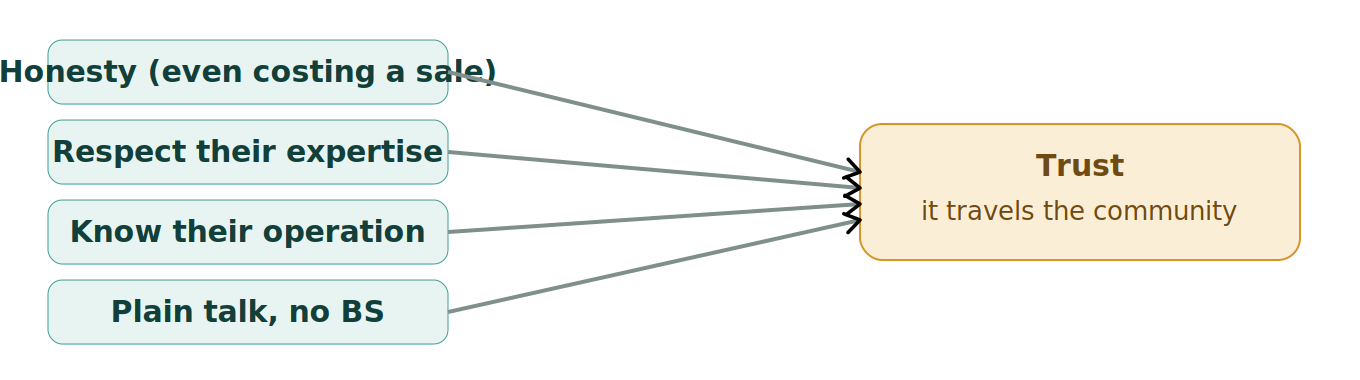
Farmers are a specific kind of customer, and working with them well comes down to a few things that can’t be faked: honesty, respect, knowing their business, and plain talk with no BS. They’re smart operators betting their livelihood on their equipment, in a tight community where reputations travel — earn their trust and you have a customer for life; lose it once and word gets around.
Trust is the entire relationship
A farmer’s equipment decisions are high-stakes bets on their operation’s success, made with real money in an uncertain business, so who they buy from and rely on is fundamentally a question of trust. That trust is built the slow way — by being honest (including when the honest answer costs you a sale), doing what you said, standing behind the work, and being straight about problems — and it’s destroyed fast by a single instance of being misled, oversold, or let down at a critical moment. In a community where farmers talk, your reputation is the sum of how you’ve treated people, and it precedes you. Everything else here serves the trust, because in this business the trust is the relationship.
Respect their expertise and know their operation
Farmers know their operations, their land, and often their equipment deeply — they are not naive buyers to be handled, and treating them as anything less is insulting and obvious. Respect that expertise: listen to what they actually need, don’t talk down to them, and recognize they can tell competence from bluster instantly. And know their business — the crops, the seasons, the economics, the specific operation in front of you — because a salesperson or tech who understands what the farmer is actually dealing with earns credibility that generic product-pushing never will. The person who knows the difference the equipment makes to this operation is worth listening to; the one reciting features isn’t.
Plain talk, no BS
Farmers value straight talk and have a fast, accurate detector for BS. Say things plainly — no jargon they don’t share, no salesman’s runaround, no overselling. If you don’t know, say so and find out; if the honest answer is “you don’t need that,” say that; if there’s a problem, tell them straight. This plainness and honesty, over time, is exactly what builds the trust — a farmer would rather deal with someone who tells them the truth plainly than someone smooth who might be working them. Being the straight, competent, honest person who knows their operation and talks to them like the capable adult they are is the whole formula, and it’s why the relationships in this business run for decades.
Where it goes wrong
- Overselling or shading the truth to close a sale.
- Talking down to farmers who know their business better than you.
- Jargon and salesman’s runaround instead of plain talk.
- Not knowing the customer’s actual operation.
Related
Who is the customer · Understanding the farmer’s business · Customer service excellence · Consultative selling.