
Who You’re Selling To
The person buying 400 horsepower for 6,000 acres of corn and the person buying a compact for a 15-acre horse property don’t value the same things and can’t be sold the same way. Reading the type in the first two minutes is the needs assessment starting before you’ve asked a spec question.
The farm types, and what each values
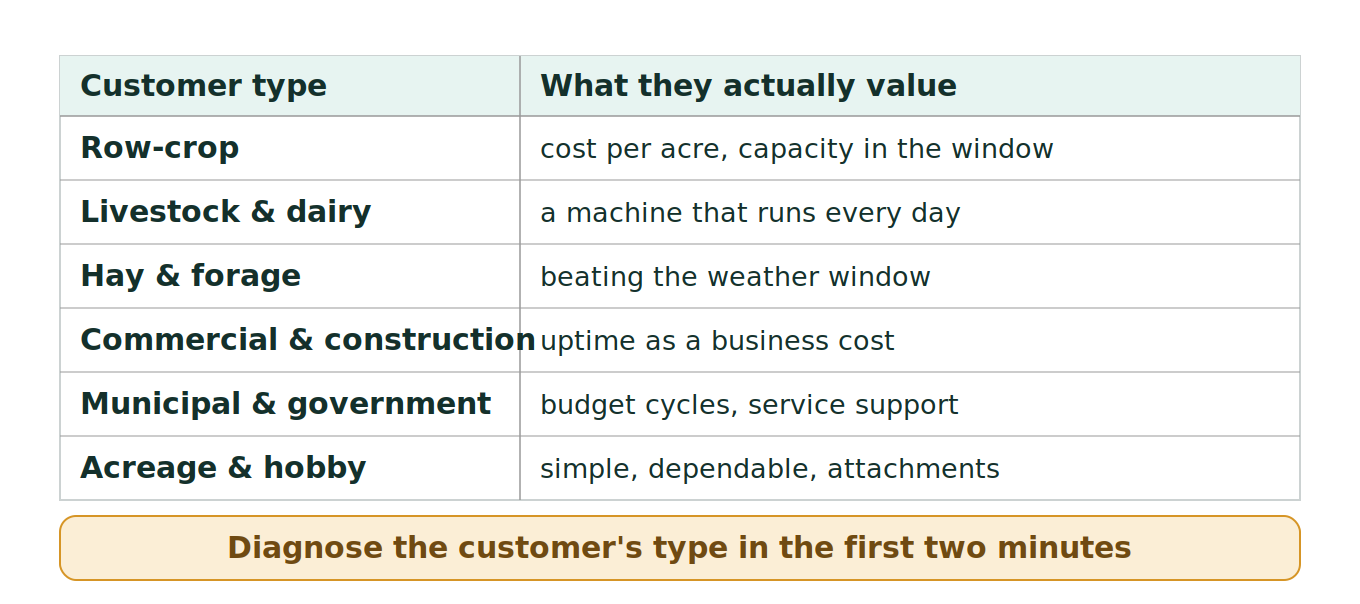
- Row-crop (corn, beans, wheat, cotton) — big acres, big machines, two hard deadlines (planting, harvest). They think cost per acre and capacity: can it cover the ground in the window? Their crisis is a combine down in October. Often shop hard and know their numbers cold.
- Livestock and dairy — the season never stops; animals eat 365 days. They value daily reliability and chores capability (loaders, mixers, skid steers) over field capacity. Downtime is daily, not seasonal — sell the machine that starts every cold morning.
- Hay and forage — live by weather windows; hay must be cut, dried, and baled in a narrow dry stretch. They value getting the crop up fast. Their crisis is rain coming with hay on the ground.
- Specialty (vegetables, orchards, vineyards, tobacco) — specific, often smaller equipment, high value per acre, easy to get wrong without knowing the crop.
- Mixed operations juggle several of these and competing seasons.
The customers who aren’t farms
Often the best margins. Commercial and construction buyers (skid steers, track loaders, telehandlers, compact tractors) think uptime and productivity as a business cost and run equipment hard. Municipalities and government buy on budget cycles and bid processes, value long-term service, and are steady and loyal once earned. Landscapers and grounds pros need daily-use durability and fast service because downtime costs them jobs. Acreage and hobby owners (10–40 acres, compact tractor, mower, loader) pay closer to retail, buy attachments, and are loyal, low-hassle, steady bread-and-butter — dismiss them at your cost.
Why type is the first diagnosis
Everything downstream changes with type. A row-cropper wants capacity and cost per acre; open with daily-reliability talk and you’ve missed. A dairy wants a machine that runs every morning; pitch planting-window capacity and you’ve missed. A municipality needs your service response and bid paperwork; talk to them like a row-cropper and you’ve missed. And worth carrying: the big operation everyone chases often shops every dealer and holds the least loyalty — worth having, not worth bleeding gross for — while the “small” acreage customer often carries better margin and less hassle.
Where it goes wrong
- Selling every customer on horsepower and price regardless of type.
- Dismissing acreage, hobby, and small-commercial buyers.
- Pitching field capacity to a livestock or dairy customer whose crisis is daily reliability.
- Ignoring a municipality’s or fleet’s buying process and losing a steady contract.
- Assuming loyalty from a big operation that treats every purchase as a fresh bidding war.
Related
Understanding the farmer’s business · The seasons of ag · Consultative selling · Fleet, large-farm, and government accounts.