
The Industry Around the Dealership
Several things the dealership does only make sense against the industry structure: you sell one manufacturer’s line inside a defined territory, the OEM holds most of the leverage, and both farms and dealers are consolidating.
Franchise and territory
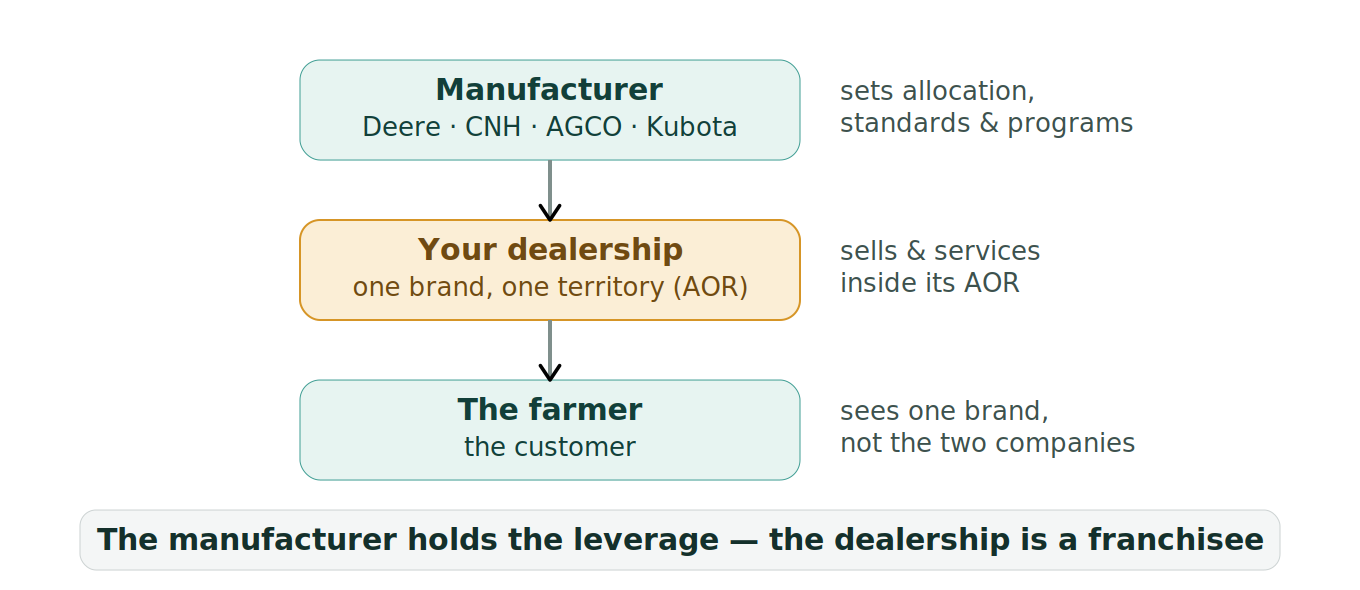
The dealership signed with one manufacturer — Deere, CNH (Case IH / New Holland), AGCO, Kubota, or another — and operates inside an area of responsibility (AOR), a territory it’s expected to cover and largely stay within. On the floor that means you can’t order a customer the competitor’s model (you sell your line, make the case for the equivalent, or keep the relationship for next time), chasing a loyal customer across another dealer’s AOR causes friction and support problems, and the OEM scores the dealership on market share inside its AOR — which is why management cares about deals that look too small to matter.
Buying patterns
Full-line loyalists buy nearly everything one color from one dealer — single-source support, one finance relationship, integrated technology; the customer the franchise system is built around. Best-in-class / mixed-fleet buyers take the strongest tool per job regardless of color — a full-line tractor but a shortline planter (Great Plains, and specialists in tillage, hay, grain handling) because it does that one thing better. Price-and-availability buyers go where the deal and delivery are, and are the hardest to keep. Read which one you’re talking to in the first conversation; it changes the whole approach.
Color loyalty
Brand loyalty in ag is real and emotional — the color is often identity, what their father ran, what showed up through thirty harvests. Two rules come off it. Never trash the other color: insulting the green machine to a green customer insults their judgment and their operation, and you lose them in a sentence. And you won’t flip a die-hard on price alone — if a loyalist is talking to you, something else is in play (a bad service experience, a machine that let them down, a need their brand doesn’t meet), and finding that is the only thing that moves them.
Who holds the leverage
The manufacturer–dealer relationship isn’t equal. The OEM controls allocation (how much inventory the dealer gets), the standards the dealer must meet, the programs and incentives that make deals work, warranty rules, and often the floor-plan financing behind the dealer’s own inventory. That’s why a dealer principal reorganizes a Saturday around an OEM audit and why “the program changes at month-end” is a real thing that moves your deals.
Consolidation, both sides
Fewer, larger farms every year — the remaining customers are bigger, more sophisticated, often with a full-time equipment manager, buying more machine per deal and expecting a salesperson who can talk their business. And fewer, larger dealers — the single-store family dealership is increasingly rare, most brands now running through multi-store groups with shared inventory and a centralized back office. Bigger territories, more demanding customers, a more corporate environment, and it isn’t reversing.
Where it goes wrong
- Promising a customer a competitor’s machine you can’t sell.
- Trashing the other color and losing a loyal customer in a sentence.
- Trying to flip a die-hard on price instead of finding the real reason they’re talking.
- Quoting stale numbers because you don’t know this quarter’s OEM programs.
- Assuming the dealership operates however it wants, then getting blindsided by an OEM standard or AOR rule.
Related
How dealers and manufacturers work together · The major OEMs and brands · Industry trends · Consultative selling.