
GNSS and Correction Signals
Everything in precision rides on knowing where the machine is, and raw satellite position isn’t nearly accurate enough for the work — the correction signal is what turns feet of error into inches, and it’s usually a subscription. The expensive misdiagnosis is blaming the receiver when the accuracy the customer pays for simply lapsed.
GNSS and why correction is needed
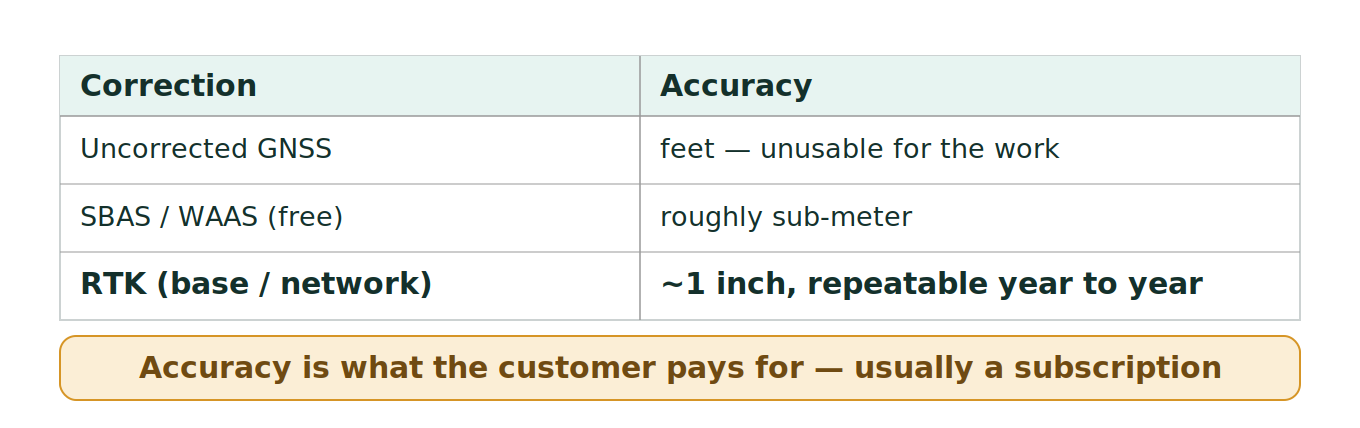
The receiver reads GNSS satellites (GPS plus GLONASS, Galileo, and BeiDou), but uncorrected position drifts by feet — useless for guidance or section control. A correction signal removes most of that error, and the accuracy level is exactly what the customer pays for: free satellite-based augmentation (SBAS/WAAS) gets roughly sub-meter, subscription satellite tiers get to inches, and RTK — from a base station or a cellular network — gets to about an inch with the repeatability to return to the same rows year after year.
Match the accuracy to the job
Guidance for tillage tolerates less accuracy than planting on repeatable rows or strip-till returning to the exact same bands. Sub-meter is fine for some spraying and guidance; inch-level RTK is what strip-till, controlled-traffic, and precise planting need. Selling the right correction tier means matching the accuracy — and its cost — to what the customer actually does, not overselling RTK to someone who doesn’t need it or underselling it to someone who does.
The subscription is the catch
Most correction beyond free SBAS is a subscription, and a lapsed subscription drops the accuracy — the “guidance quit being accurate” call is often an expired correction, not a failed receiver. Track renewals, and on any accuracy complaint check the subscription, the sky view, and (for RTK) the base station or network before condemning hardware.
Where it goes wrong
- Replacing a receiver when the correction subscription lapsed.
- Selling the wrong accuracy tier for the customer’s actual work.
- Ignoring subscription renewals until accuracy drops mid-season.
- Overlooking sky view or base-station issues on an accuracy complaint.