
Variable-Rate Technology
Variable rate applies inputs at different rates across a field instead of one flat rate everywhere — more seed or fertilizer where the ground will pay for it, less where it won’t. Done from a sound prescription it optimizes inputs and yield; done from a bad map it just misplaces money precisely.
Applying to the zone, not the flat rate
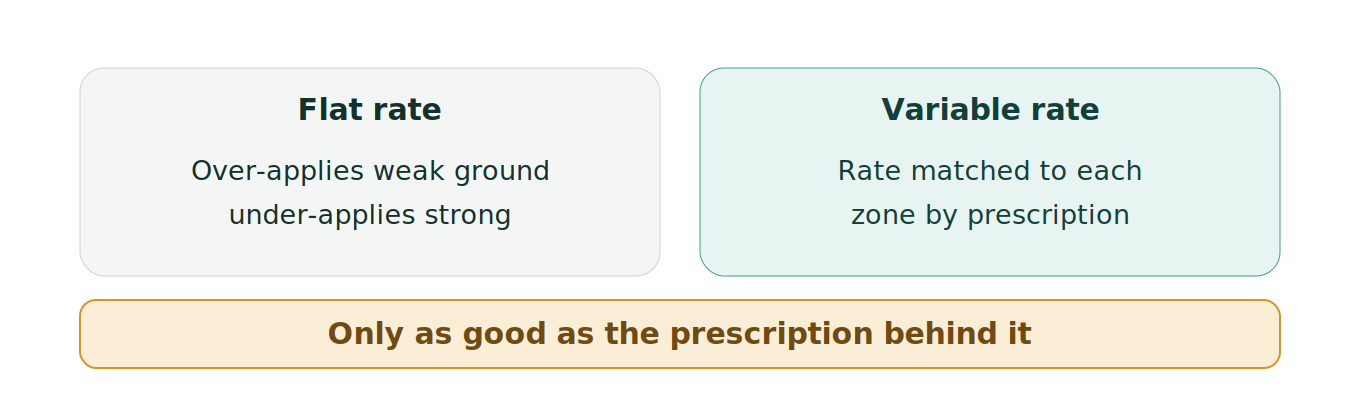
Fields aren’t uniform — soil type, fertility, and yield potential vary across them — and a flat rate over-applies on the weak ground and under-applies on the strong. Variable rate (VRT) applies inputs (seed population, fertilizer, chemical, lime) at rates that change across the field per a prescription map, matching each zone. The value is input efficiency and yield: not wasting inputs where they won’t return, and putting them where they will.
It takes three things
VRT needs the prescription (the agronomic decision — from yield history, soil tests, imagery, or an agronomist — about what rate goes where), the controller and display to execute it, and the equipment capable of varying the rate (variable-drive meters, rate controllers). The dealership supplies and supports the equipment and controllers; the prescription is agronomy, often from the customer or their agronomist, and the honest line is that VRT is only as good as the prescription behind it. Good iron on a bad map wastes inputs with precision.
The value depends on the data
Because the payoff rides on the prescription, VRT ties directly to yield mapping and data — the maps that reveal the zones come from good, calibrated yield and soil data. Sell VRT as part of a data-driven system, and set the customer’s expectation that the return comes from a sound prescription, not the hardware alone.
Where it goes wrong
- Selling VRT hardware without addressing the prescription behind it.
- Running variable rate off a poor or uncalibrated map.
- Treating VRT as plug-and-play instead of a data-driven system.
- Promising input savings the prescription can’t actually deliver.
Related
Yield monitoring, mapping, and calibration · Section and row control · Data platforms · Reading data and talking ROI.