
The Major OEMs and Brands
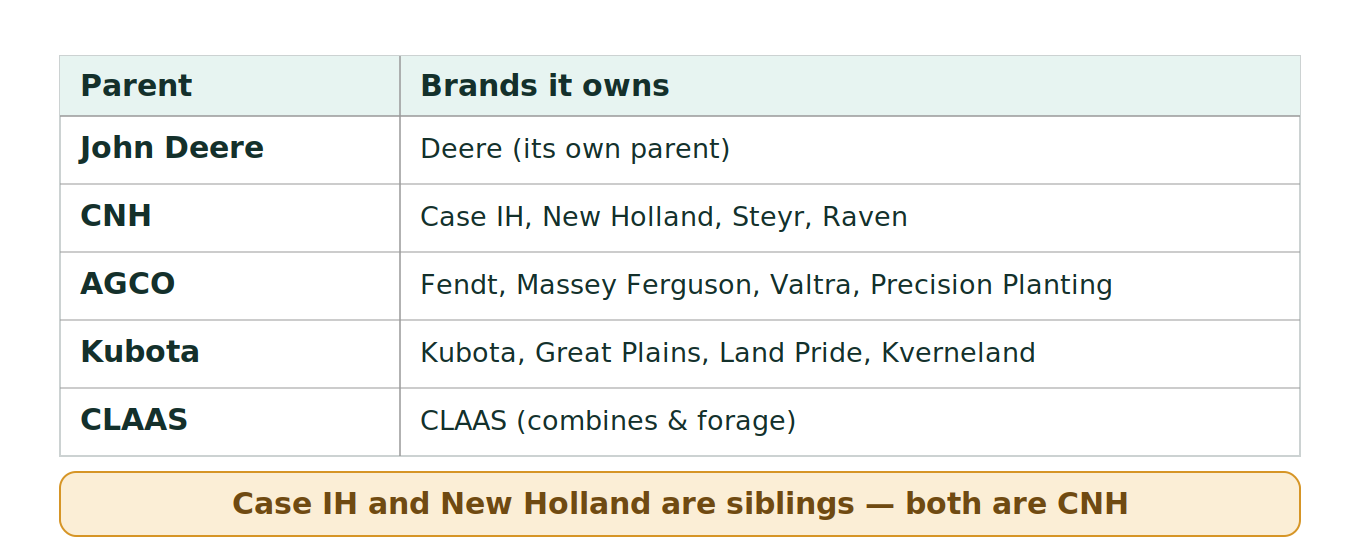
A handful of parent companies own most of the badges, and the map matters on the floor: it decides what parts cross, what technology shares, and who your real competition is. Get a brand wrong in front of a customer who’s run both for thirty years and you read as green instantly.
The full-line majors
- John Deere — market leader, its own parent, running the industry’s most developed precision ecosystem (Operations Center, guidance, a tightly integrated proprietary stack). A Deere customer is often deep in that ecosystem — a loyalty moat and a switching cost both.
- CNH — parent of Case IH (red) and New Holland (blue), plus Steyr and the Raven precision brand. Case IH and New Holland are corporate siblings: they compete and keep separate dealers, but share a great deal of engineering and components underneath, which explains parts and platform overlap that looks strange otherwise.
- AGCO — parent of Fendt (premium), Massey Ferguson, Valtra, the Gleaner combine, and — importantly — Precision Planting and the PTx technology group. AGCO leans into brand-agnostic precision that goes onto other companies’ iron, which matters for data and retrofit conversations.
- Kubota — dominant in compact and utility and moving up; owns implement makers Land Pride and Great Plains and the tillage/seeding brand Kverneland. A Kubota compact customer is often buying Land Pride to match.
- CLAAS — European, known especially for combines and forage; footprint varies by region.
Compact, utility, and rebadging
In the sub-compact-through-utility market the “who actually builds it” question is real, because the same factory often builds a machine sold under several names. Mahindra, Kioti, LS, TYM, Yanmar, and Iseki compete hard on price and value. Kioti is the North American brand of Korea’s Daedong — not related to Kubota despite the sound-alike. Bobcat (Doosan) is a giant in skid steers and compact equipment; JCB is strong in telehandlers. A compact’s badge doesn’t always tell you who engineered it, so know which of your lines are built versus rebadged.
Shortline specialists
Plenty of the best equipment on a farm isn’t from a full-line major — shortlines build one category exceptionally well (planters, tillage, grain handling, hay, sprayers). A full-line-tractor customer running a shortline planter is buying the best tool for that job, not confused.
Why the map matters
Parts and platforms cross more than the paint suggests — corporate siblings share components, and some “different” machines are the same machine in another color, which is why a part shows up under two brands and how supersessions and cross-references behave. Precision ownership drives compatibility: Deere’s stack is proprietary and integrated; AGCO’s Precision Planting and PTx are deliberately brand-agnostic for mixed fleets, which decides what you can promise about data and retrofits. And your competition is specific: sell red and your fights are with green and blue — blue being your own corporate sibling. Ownership shifts as companies buy brands and precision startups, so keep the map current.
Where it goes wrong
- Calling corporate siblings “totally different companies,” or missing that they share engineering.
- Confusing Kioti (Daedong) with Kubota.
- Not knowing who actually builds a rebadged compact you’re selling.
- Promising cross-brand parts or data compatibility without knowing the platform reality.
- Naming the wrong parent in front of a customer.
Related
The industry at a glance · How dealers and manufacturers work together · Selling precision ag · Part numbers and supersessions.