
OSHA Essentials
Enough of the framework to know your rights, the dealership’s obligations, and the recordkeeping that carries real consequences.
The General Duty Clause
Beyond specific standards, employers owe a workplace free of recognized serious hazards. That’s the catch-all behind most of what safety programs address — a known hazard that isn’t controlled is a violation even without a specific rule naming it.
Recordkeeping and the reporting clocks
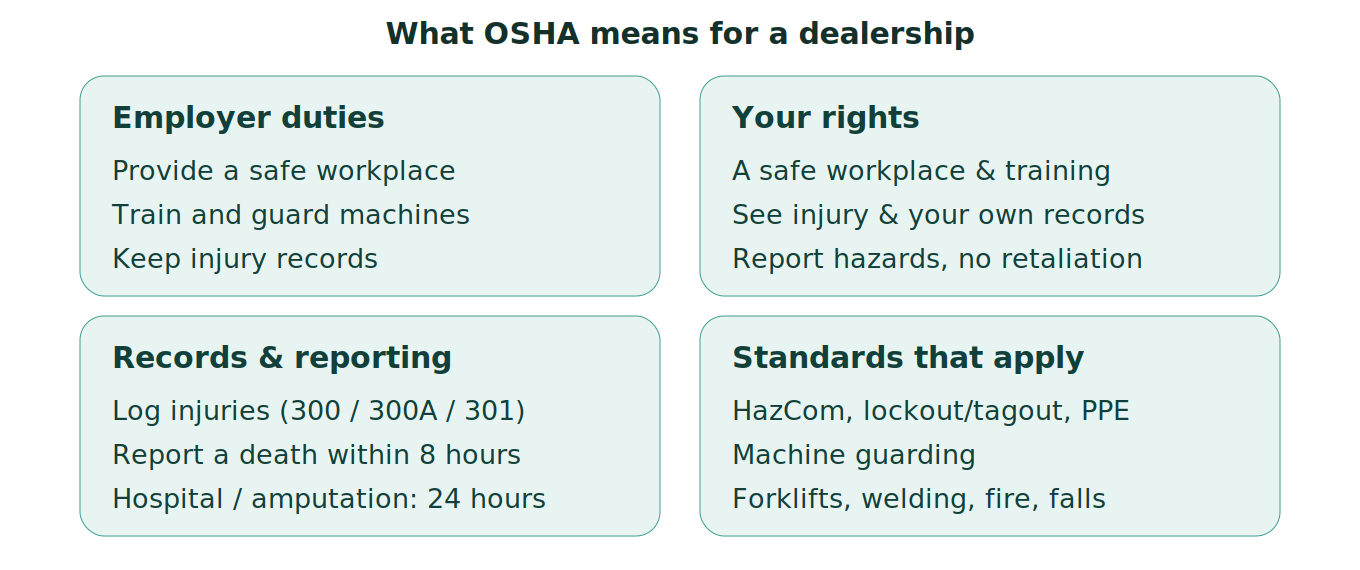
Covered employers log work-related injuries and illnesses: Form 300 (the log), 300A (the annual summary that gets posted), and 301 (the incident report). And there are hard reporting clocks that people miss: a work-related fatality must be reported within 8 hours; an in-patient hospitalization, amputation, or loss of an eye within 24 hours. Missing these clocks is its own violation on top of the incident.
Your rights, and no retaliation
Workers have the right to a safe workplace, to information about hazards, to report unsafe conditions, and to request an inspection — and retaliation for exercising those rights (including whistleblower protections) is itself illegal. Reporting a hazard or an injury is protected, which matters because the fear of retaliation is what keeps hazards hidden until someone’s hurt.
Where it goes wrong
- Assuming no specific rule means no obligation (the General Duty Clause covers it).
- Missing the 8-hour and 24-hour reporting clocks.
- Failing to keep or post the required records.
- Retaliating against, or fearing retaliation for, a safety report.
(General information, not legal advice; follow your dealership’s policies and current regulations.)
Related
Building a dealership safety program · Incident reporting · Environmental rules · Shop and yard safety.