
Working a Territory
A territory is a portfolio to be worked deliberately, not a route to drive around reactively. Cover it by allocating your limited time to where the opportunity is — not by responding to whoever calls and visiting the accounts you enjoy.
Tier the accounts
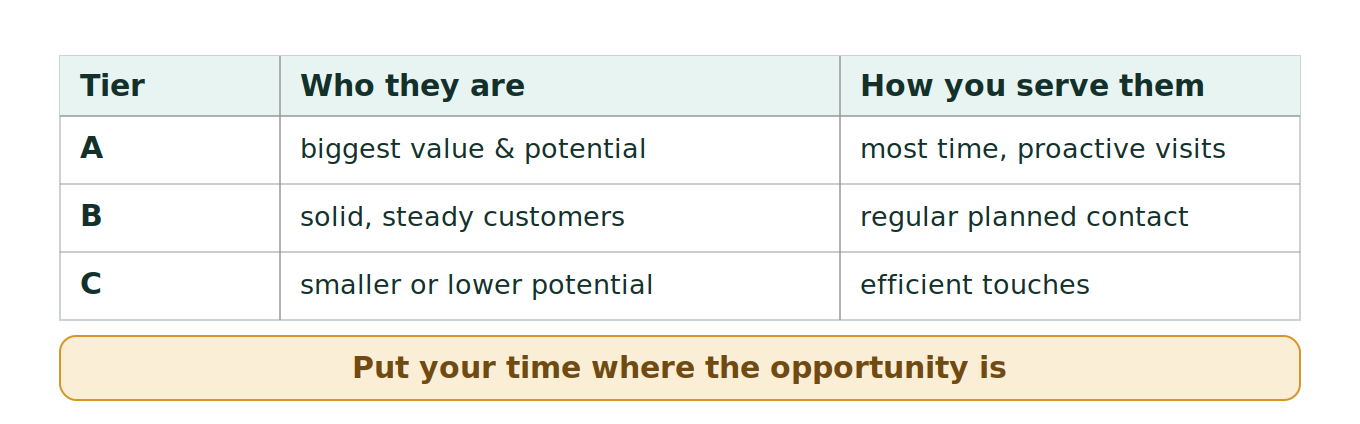
A accounts are the largest customers and highest-potential prospects — the most face time and proactive visits; a handful of them often drive most of the business. B accounts are solid and steady, worth regular planned contact. C accounts are smaller or lower-potential, served efficiently. Match the investment to the opportunity so you’re not spending A-level time on a C account while an A drifts to a competitor.
Don’t over-serve the comfortable, and plan the route
The common failure is emotional: over-investing in the friendly, easy accounts and under-investing in the demanding big one or the uncomfortable prospecting. In a rural territory, drive time is expensive — group visits geographically, combine a delivery follow-up with nearby prospecting, and you recover hours a week. The CRM tells you who’s due and whose equipment is aging into a trade, and the plan flexes with the season (reactive in-season, the planned relationship circuit off-season, when customers have time to talk).
Where it goes wrong
- Working the territory reactively instead of by a plan.
- Over-serving comfortable accounts and neglecting bigger opportunities.
- Crisscrossing the territory and burning the week in windshield time.
- Ignoring the CRM and the seasonal rhythm.
Related
Using a CRM · Prospecting · Fleet and large accounts · The seasons of ag.