
Structuring Deals: Terms, Rates, Residuals
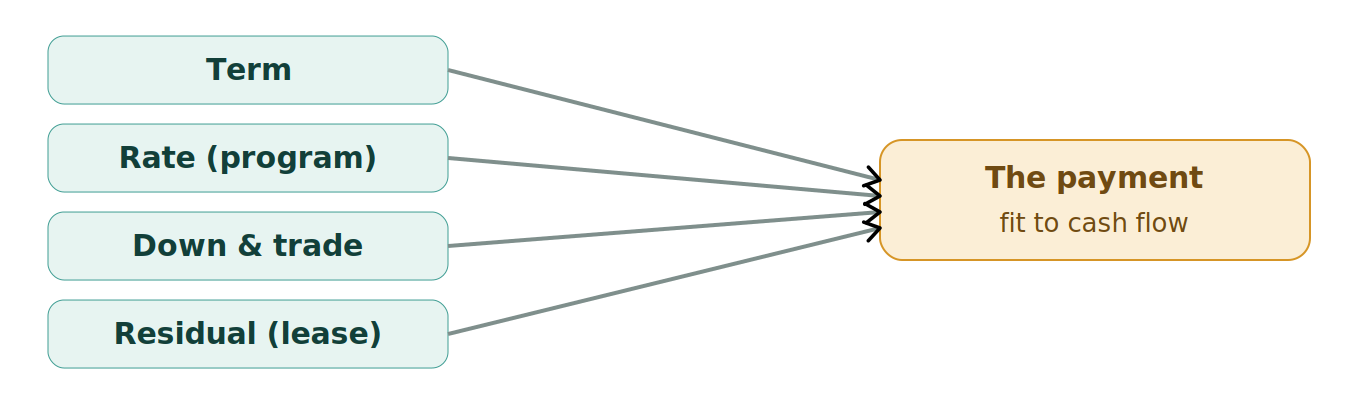
Most customers buy a payment, and structuring is how you build a payment that fits the customer’s cash flow and closes the deal — moving term, rate, down payment, trade, and (on a lease) residual to land where it works. The levers interact, and the honest structure serves the customer rather than hiding cost in a longer term.
The levers that move the payment
Term — a longer term lowers the payment and raises total interest paid; rate — the subsidized program rate versus standard money, the single biggest lever when a program’s running; down payment and trade — more down (or a bigger trade difference applied) lowers the amount financed; and on a lease, the residual — the machine’s estimated end-of-term value, where a higher residual lowers the payment because the customer finances less of the machine. These interact: the same payment can be reached different ways, with different total costs and ownership outcomes.
Fit the money cycle, reach for the program
A farmer’s harvest-driven income means the structure often matters more than the rate: seasonal and deferred payments (“nothing till after harvest”) match money out to money in and close deals a lower price wouldn’t. And the subsidized program rate is usually the first lever to reach for — cheap money from the captive beats cutting price out of gross. Build the structure around the customer’s cash flow and the available program, not around the longest term that hides the cost.
Structure honestly
A longer term or a thin down payment can produce a comfortable payment that leaves the customer underwater or paying far more interest than they realize — structuring honestly means the customer understands the trade-offs, not just the monthly number. And residuals, rates, and program eligibility have to be real, not optimistic — a structure built on numbers that don’t hold falls apart at signing.
Where it goes wrong
- Stretching the term to hide cost instead of structuring honestly.
- Cutting price instead of reaching for the subsidized program.
- Ignoring the seasonal cash cycle in the payment structure.
- Building a structure on residuals or rates that don’t hold up.
Related
Financing and lease basics · Subsidized financing, waivers, and buydowns · Understanding the farmer’s business · Finance vs. lease vs. cash.
(General information, not financial advice; customers should consult their own advisors.)