
Succession and Exit Planning
Every owner and every key leader eventually leaves, and the dealerships that survive the transition are the ones that planned for it years ahead. Succession planning is uncomfortable — it means confronting your own exit and mortality — which is exactly why so many put it off until a crisis forces a bad outcome.
Plan the transition before you need to
Succession is the deliberate preparation for the handover of ownership and key leadership — to the next generation, to a partner or manager, or to a buyer — and it takes years to do well: developing and proving successors, structuring the ownership transfer, handling the financial and tax complexity, and transferring the relationships and knowledge that walk out with the departing leader. The failure is avoidance: putting it off because it’s uncomfortable or “not yet,” until a death, illness, falling-out, or forced sale triggers a rushed, value-destroying transition. Planning early — while there’s time to develop people and structure it well — is what protects the business, the family, and the employees.
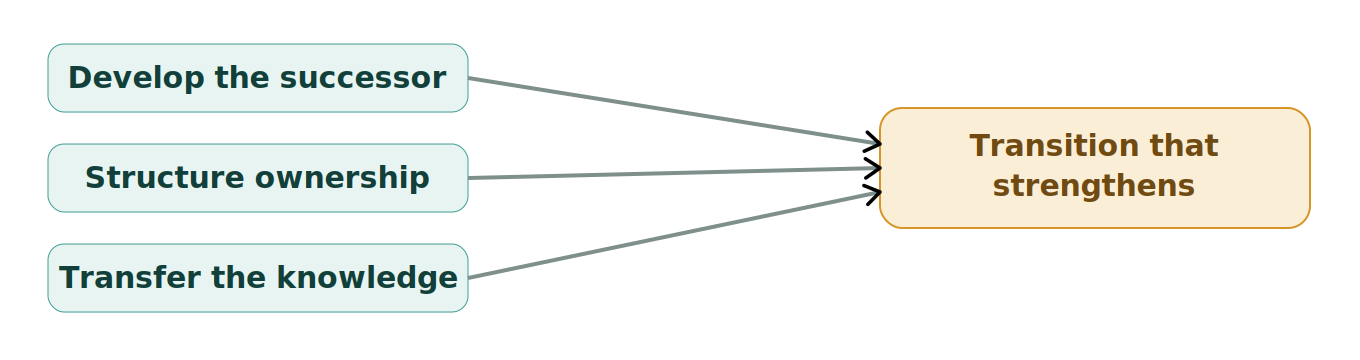
Develop the successor, transfer the knowledge
A succession plan is only as good as the successor, and developing one takes time and honesty — identifying who can lead (family or not), giving them real responsibility and proving grounds, and being clear-eyed about whether they’re actually ready rather than just next in line. Family succession carries its own complications (capable heir vs. entitled one, fairness among siblings, mixing family and business), and sometimes the right successor is a manager or an outside buyer rather than blood. Crucially, the departing leader’s relationships and hard-won knowledge — with customers, the OEM, lenders, the team — have to be deliberately transferred, or they leave when the leader does and the successor inherits a weakened business.
Structure the ownership and money
Beyond the people, succession involves the financial and legal machinery — how ownership transfers, how it’s valued and financed, the tax and estate implications, the OEM’s approval of the new owner (the franchise isn’t automatically transferable), and the retiring owner’s financial security. These are complex, they take time to structure well, and they’re the province of qualified legal, tax, and financial advisors — not something to improvise. The management point is to start the planning early enough that the structure can be built deliberately and the successor developed, rather than forced into a fire sale when circumstances take the choice away.
Where it goes wrong
- Avoiding succession planning until a crisis forces a bad transition.
- Naming a successor by default without developing or honestly assessing them.
- Letting relationships and knowledge walk out with the departing leader.
- Improvising the ownership and tax structure instead of planning it with advisors.
Related
Buying and selling dealerships · Hiring and building a bench · Strategic and business planning · Managing the OEM relationship.
(General information, not legal, tax, or financial advice; consult qualified advisors.)