
Parts Financials and Margin
Parts is a business inside the business, and its numbers decide how much of the dealership’s absorption it carries. Reading them means seeing past total sales to margin, turns, and the health of the capital tied up in inventory.
Gross margin is the number, not sales
Parts sales volume looks impressive and says little on its own; gross margin — sales minus the cost of the parts — is what feeds absorption, and it’s protected by the price matrix, healthy on low-cost parts and thinner on expensive ones. Discounting, off-system pricing, and giving retail customers wholesale rates all bleed the margin the department exists to produce. Parts gross commonly runs high-30s to low-40s percent, and holding it across thousands of transactions is the whole game.
Inventory is capital, and turns measure it
The parts inventory is a large asset — cash converted into stock — and turns measure how hard that capital works. High turns mean the money recycles into gross repeatedly; low turns mean cash frozen in parts that sit. Obsolescence is capital actively dying on the shelf, which is why managing the slow tail and using return programs shows up directly in the financials. A department can post good sales and still be unhealthy if its capital is stuck in dead stock.
The numbers that read health
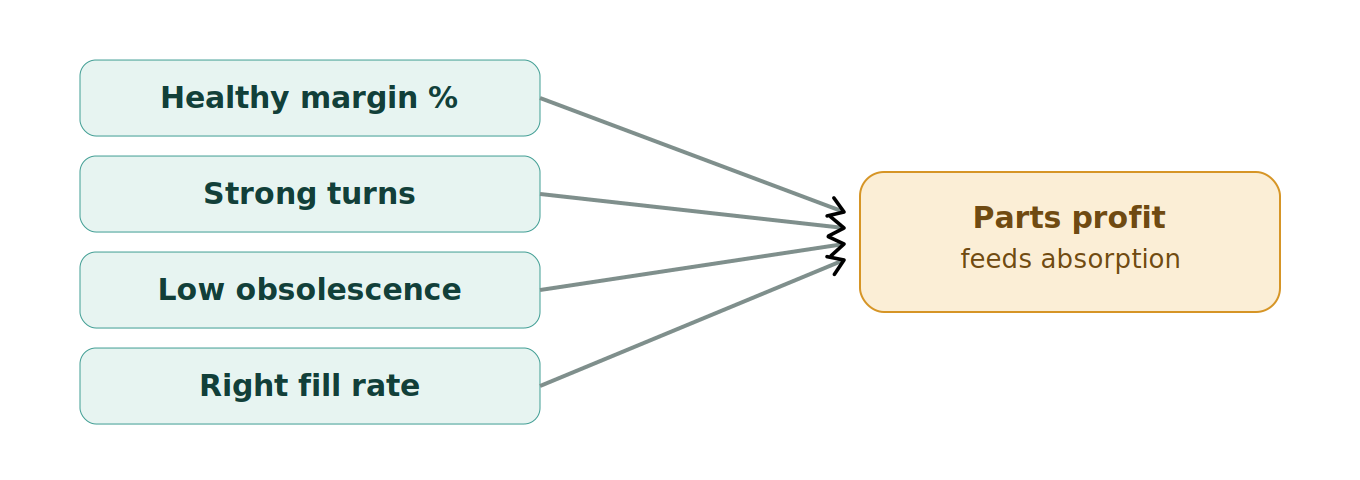
Gross margin percent and trend, turns by category, inventory value against sales, obsolescence and aging, and fill rate against turns — together these read whether the department is carrying its share of absorption or just moving volume. Sales alone hide a department drowning in slow inventory.
Where it goes wrong
- Judging the department by sales volume instead of gross margin.
- Bleeding margin through off-system discounting.
- Ignoring frozen capital in slow and dead stock.
- Reading any single number without turns and obsolescence beside it.
Related
How a dealership makes money · Parts pricing and matrices · Inventory health: turns and fill rate · Managing obsolescence.