
Parts Pricing and Price Matrices
Not every part carries the same markup, and a flat markup leaves real money on the table. A price matrix sets margin by the part’s cost and price sensitivity — and the counterintuitive rule at its center is that inexpensive, low-visibility parts carry higher markup percentages than expensive, price-shopped ones.
Why cheap parts take higher markup
A customer who needs a $4 clip, an O-ring, or a cotter pin isn’t price-shopping it — they need it, the absolute dollars are trivial, and a high markup percentage on it is invisible and painless. A $900 hydraulic pump is different: the customer knows roughly what it costs, may call around, and a fat markup gets shopped away. So a matrix marks low-cost parts up steeply (in percentage terms) and expensive, visible parts more modestly, capturing margin where the customer is insensitive and staying competitive where they aren’t.
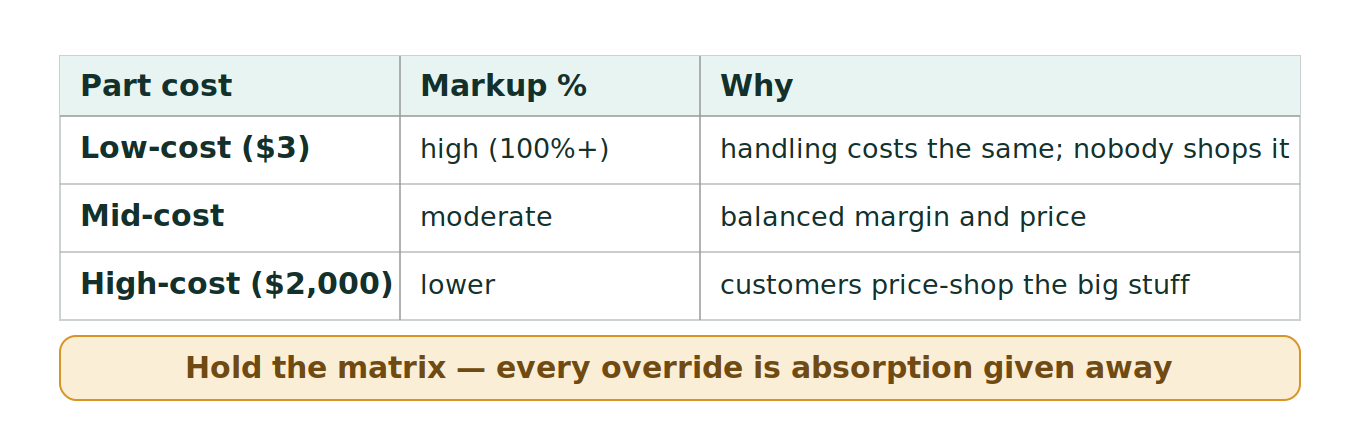
The matrix protects gross across thousands of lines
Applied automatically at point of sale across every transaction, the matrix earns a large share of parts gross and therefore of absorption. This is why the parts manager holds the matrix on a fast-moving low-cost part instead of discounting it — a point of margin across thousands of those transactions a year is real money, and it’s the number that keeps people employed.
Wholesale and key accounts price differently
High-volume wholesale and key accounts get different (lower) pricing tiers by agreement, which is a deliberate trade of margin for volume — not a reason to discount retail counter sales, where the matrix margin is the point.
Where it goes wrong
- Applying a flat markup and leaving margin on low-cost parts.
- Discounting cheap, price-insensitive parts the customer would never shop.
- Overpricing expensive, visible parts and getting shopped away.
- Giving retail customers wholesale pricing off-system.
Related
Point of sale in the DMS · Parts financials and margin · Wholesale parts and key accounts · How a dealership makes money.