
Wholesale Parts and Key Accounts
High-volume wholesale and key accounts trade margin for volume, and run right they add steady, predictable business that keeps parts moving. Run wrong they consume the department’s service and inventory at prices that don’t cover it — so the terms and the boundaries matter.
Volume for margin, by agreement
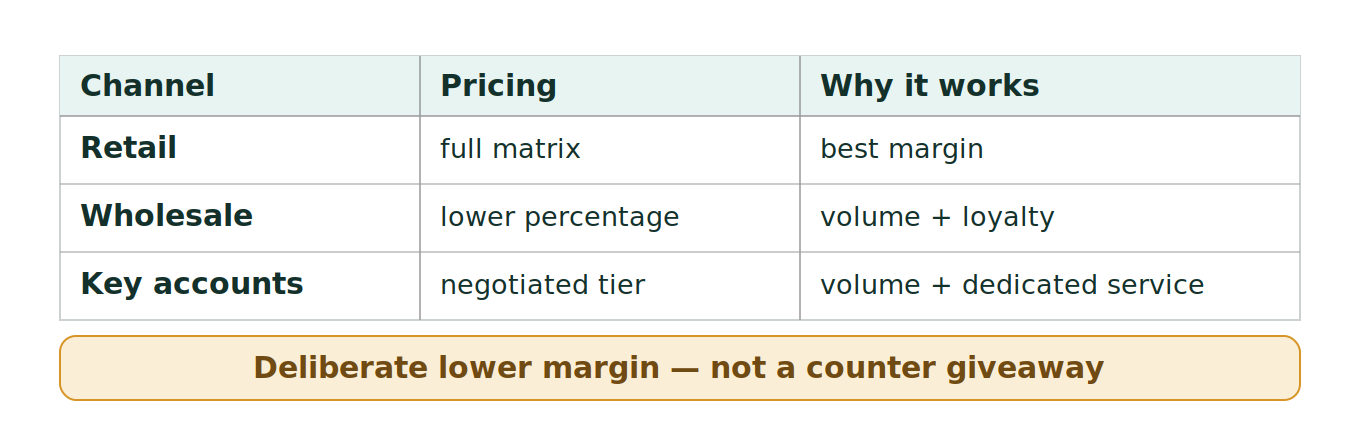
Wholesale customers — repair shops, large operations, other resellers — buy in volume at lower, tiered pricing set by agreement. The trade is deliberate: thinner margin per part for steady volume that turns inventory and contributes gross in aggregate. The key is that it’s by agreement, at defined tiers — not ad-hoc discounting that leaks retail margin, and not pricing so thin the volume doesn’t actually pay.
Serve them without cannibalizing retail
The boundary that protects the department: wholesale pricing stays with wholesale accounts, and doesn’t bleed into the retail counter where the matrix margin is the point. A retail customer given wholesale pricing is pure lost gross. And a key account’s volume can’t be allowed to strip the shelf of parts the shop and retail customers need — allocation and stocking account for their demand rather than letting them empty the bins.
Manage terms and the relationship
These accounts run on credit terms, service levels, and a relationship — reliable supply, correct orders, and problems handled keep a volume account loyal, while stockouts and errors send a high-volume buyer to a competitor fast. Set credit and terms up front, and treat the account as the steady, predictable business it is.
Where it goes wrong
- Ad-hoc wholesale discounting instead of defined tiers.
- Letting wholesale pricing bleed into retail counter sales.
- Allowing a key account to strip stock the shop and retail need.
- Neglecting terms and service and losing a volume account.
Related
Parts pricing and matrices · Inventory basics · Parts financials and margin · Fleet and large accounts.