
Point of Sale Is Data Entry
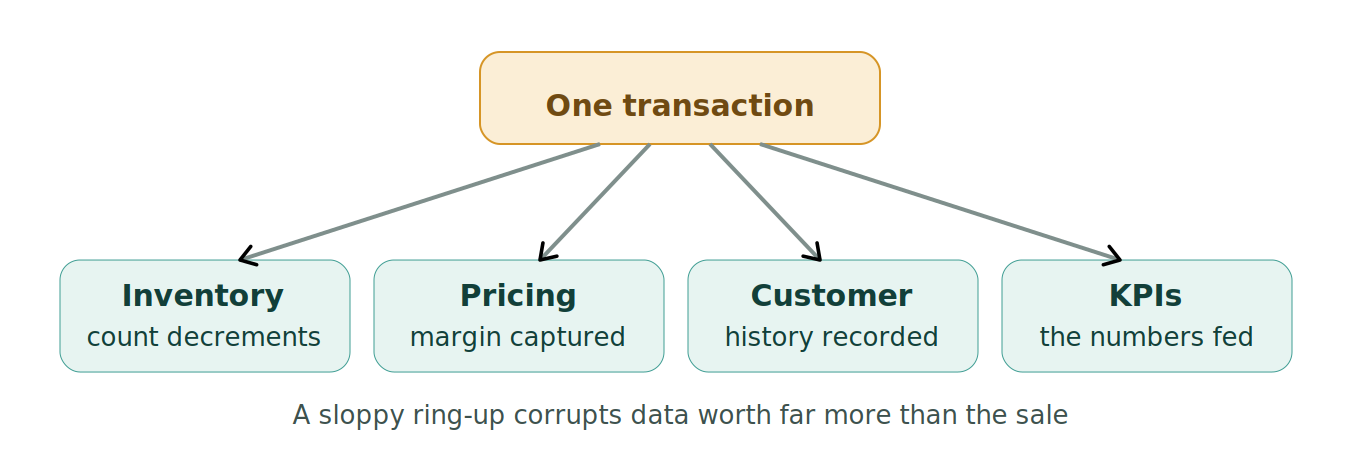
Every parts transaction is also a data event that drives availability, reorder, pricing, and financial reporting. A part sold under the wrong number or off the books rings up fine and quietly corrupts the counts, the reorder math, and the picture management runs the department on. The register is the front end of the whole inventory system.
The transaction feeds everything downstream
Selling the exact part under its correct number decrements the right stock, keeps the on-hand accurate, and lets the reorder system restock correctly. Sell the wrong number and you’ve drifted two counts — the one you sold reads high, the one you should have sold reads low — and both reorder wrong. The five-second shortcut at the register becomes a stockout on one part and overstock on another.
Never sell around the system
Handing a part across the counter without ringing it, or writing it down to enter “later,” breaks the count in real time — the shelf is short but the system isn’t, so it won’t reorder, and the department is now flying on numbers that lie. Cash sales, internal-use parts, and warranty parts all get entered the right way so the counts and the financials stay honest.
Price and margin are captured here too
The price matrix and margin get applied and recorded at point of sale, so discounting off-system or keying the wrong price both loses gross and corrupts the department’s margin reporting. Ring it right and the numbers management sees are real.
Where it goes wrong
- Selling a part under the wrong number and drifting the counts.
- Handing parts over without ringing them, or “entering it later.”
- Not entering internal-use, cash, or warranty parts properly.
- Discounting or mis-keying price off-system.
Related
The DMS · Inventory basics: min/max/reorder · Parts pricing and matrices · Physical inventory and cycle counting.