
Selling Parts Online
Online parts sales extend the counter to customers who research and buy at midnight, and the channel is real business — but it competes on price and convenience against everyone, and it has to be run without starving the local customers and the shop that carry the department.
Why the channel matters
Customers increasingly look up and buy parts online, on their schedule, and a dealership absent from that channel cedes those sales to online sellers and other dealers. Done well, e-commerce reaches beyond the local territory, serves the after-hours and self-service customer, and moves stock — including slow-movers that find a buyer somewhere in a national pool.
It’s a price-transparent, fulfillment-heavy channel
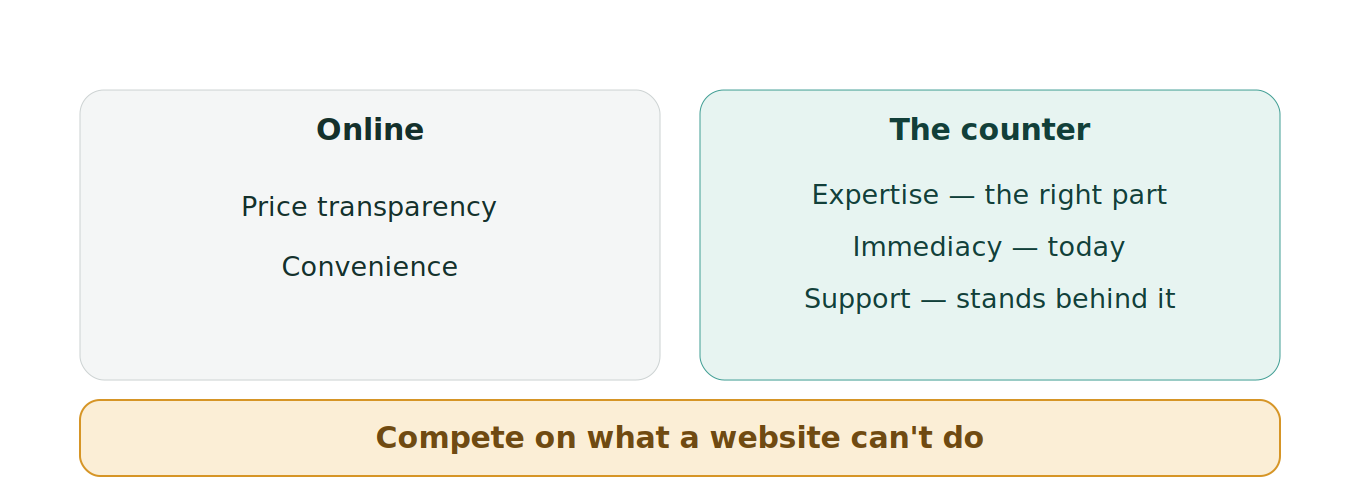
Online, the customer sees everyone’s price at once, so the fat matrix margin on obscure parts is harder to hold and the channel runs on competitive pricing and volume. And it’s operationally demanding: accurate online catalog data (right part to the right machine, or you ship wrong and eat returns), real stock accuracy, and prompt pick-pack-ship fulfillment. Sloppy inventory data that’s survivable at the counter becomes wrong shipments and bad reviews online.
Don’t starve the counter and the shop
The discipline: online orders can’t consume the stock the local customer and the service shop depend on, and the pricing and effort put into online can’t undercut the higher-margin, relationship-driven local business that actually carries absorption. Online is an addition to the counter and the shop, not a replacement — balanced so it captures new business without cannibalizing the core.
Where it goes wrong
- Ignoring the channel and ceding those sales entirely.
- Bad online catalog or stock data causing wrong shipments and returns.
- Slow fulfillment that earns bad reviews.
- Letting online orders starve the counter and the shop.
Related
Point of sale in the DMS · Parts pricing and matrices · Inventory health · Wholesale parts and key accounts.