
Where Parts Live: Slotting and Bins
A warehouse is organized so parts can be found fast and put away right, and the layout isn’t arbitrary — it’s built around velocity, so the parts pulled fifty times a day are within reach and the ones pulled twice a year aren’t taking prime real estate. Good slotting saves steps on every transaction; bad slotting taxes every pull.
Slot by velocity
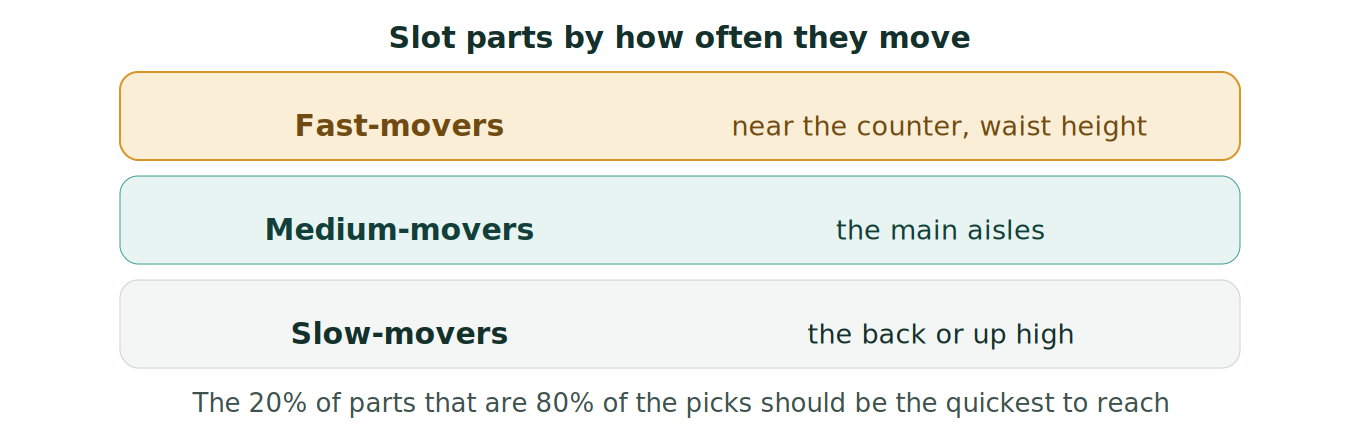
Fast-movers go in the most accessible locations — close to the counter, at working height, easy to grab — because they’re touched constantly and every step saved multiplies across the day. Slow-movers and bulky items go to less prime space. This velocity-based slotting is what makes a counter fast; a warehouse organized by part number or by accident makes someone walk the building for a common filter.
The bin location is only as good as its accuracy
Every part has a bin location in the system, and the whole point is that anyone can find any part by trusting that location. That trust breaks the moment a part is put away in the wrong bin or a location isn’t updated — now the system says one thing and reality says another, the part reads as “out of stock” when it’s on the shelf (a phantom stockout), and someone orders more of what’s already there. Bin accuracy is what makes the warehouse findable, and it’s made or broken at put-away.
Organized is safe and sellable
A clean, logically slotted warehouse is faster, safer (heavy items low, clear aisles), and easier to inventory. Clutter and disorder cost time on every transaction and hide the discrepancies that corrupt the counts.
Where it goes wrong
- Slotting by part number or habit instead of velocity.
- Putting parts away in the wrong bin or not updating locations.
- Creating phantom stockouts that trigger needless reorders.
- Letting the warehouse get cluttered and slow.
Related
Receiving and put-away · Inventory basics: min/max/reorder · Physical inventory and cycle counting · The DMS.