
Lockout/Tagout: Off Is Not Safe
Switching a machine off does not make it safe to work on. Energy stays stored in it, and a machine that starts, moves, or releases that energy while your hands are inside it maims or kills. Lockout/tagout is the discipline that brings the machine to a verified zero-energy state and keeps it there until you’re clear.
Off ≠ de-energized
Stored energy hides in more forms than the power switch controls: hydraulic pressure in lines and accumulators, a raised implement held by gravity, a compressed or stretched spring, capacitors and residual electrical charge, pneumatic pressure, and rotating mass still coasting. Any of these can move a machine or a component after it’s “off.” De-energizing means addressing every one — bleeding pressure, lowering or blocking raised parts, discharging, relieving.
Your lock, your life
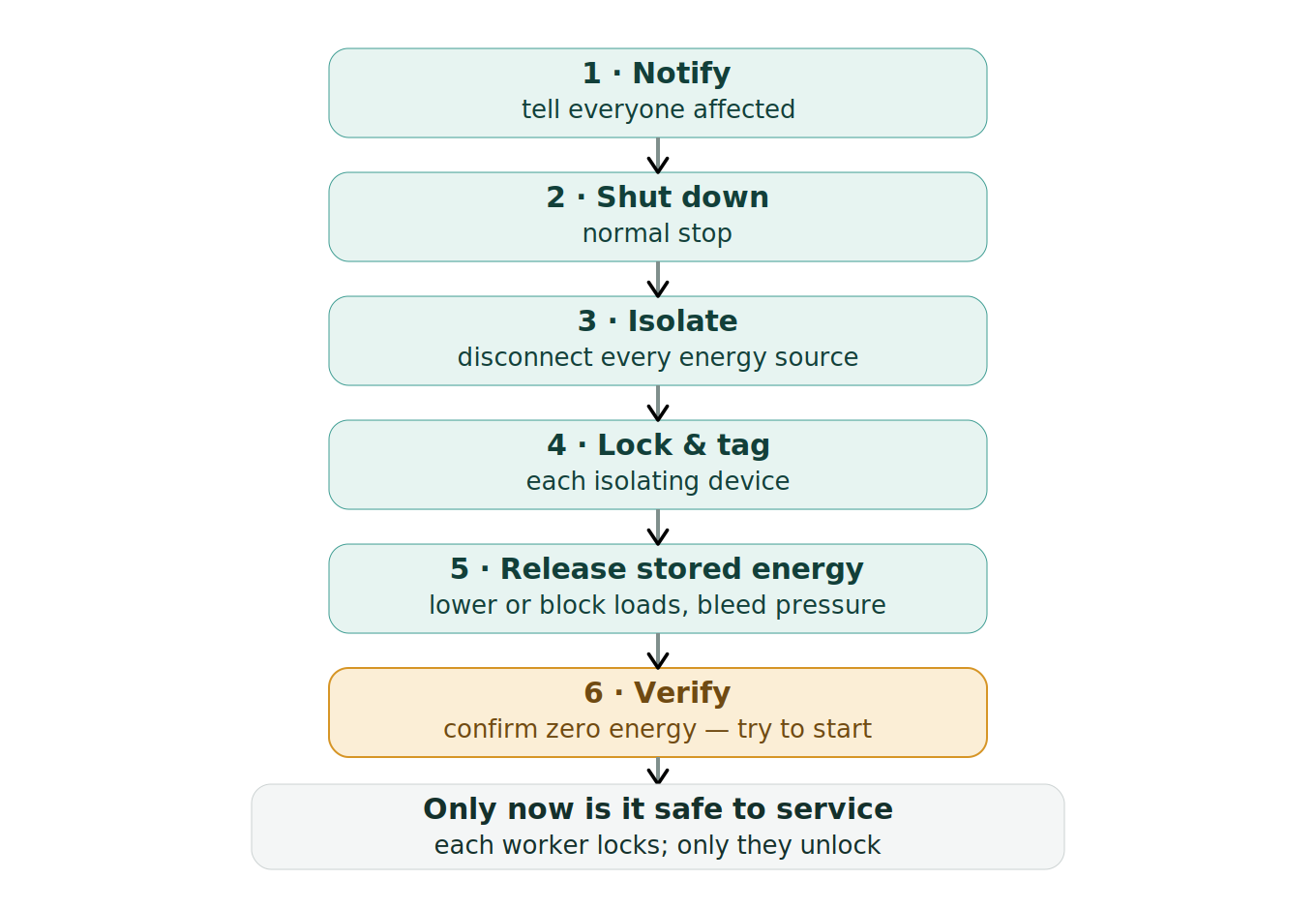
The rule that makes it work: the person doing the work applies their own lock, and only that person removes it. One lock, one person, one key. Never rely on someone else’s lockout, never remove another person’s lock, and where several people work on one machine, each applies their own. A tag alone is a warning, not a control — the lock is what physically prevents re-energizing.
Verify zero energy
The step people skip and shouldn’t: after locking out and releasing stored energy, verify the machine is actually dead — try to start it, test for voltage, confirm pressure is bled. Assuming it’s safe and testing that it’s safe are different things, and the gap between them is where people get hurt.
Where it goes wrong
- Treating the power switch as if it made the machine safe.
- Ignoring stored hydraulic, gravity, spring, or electrical energy.
- Relying on someone else’s lock, or removing another person’s.
- Skipping the verify step and assuming zero energy.
Related
Hydraulic and stored energy hazards · Shop and yard safety · Handling batteries · Preventive maintenance.