
Transporting Equipment: DOT and CDL
Hauling equipment for the dealership is commercial transport, and the rules that apply are not the farm rules customers operate under. Getting the license class, the securement, and the permits wrong exposes the driver and the dealership to real liability.
CDL class by rating, not load
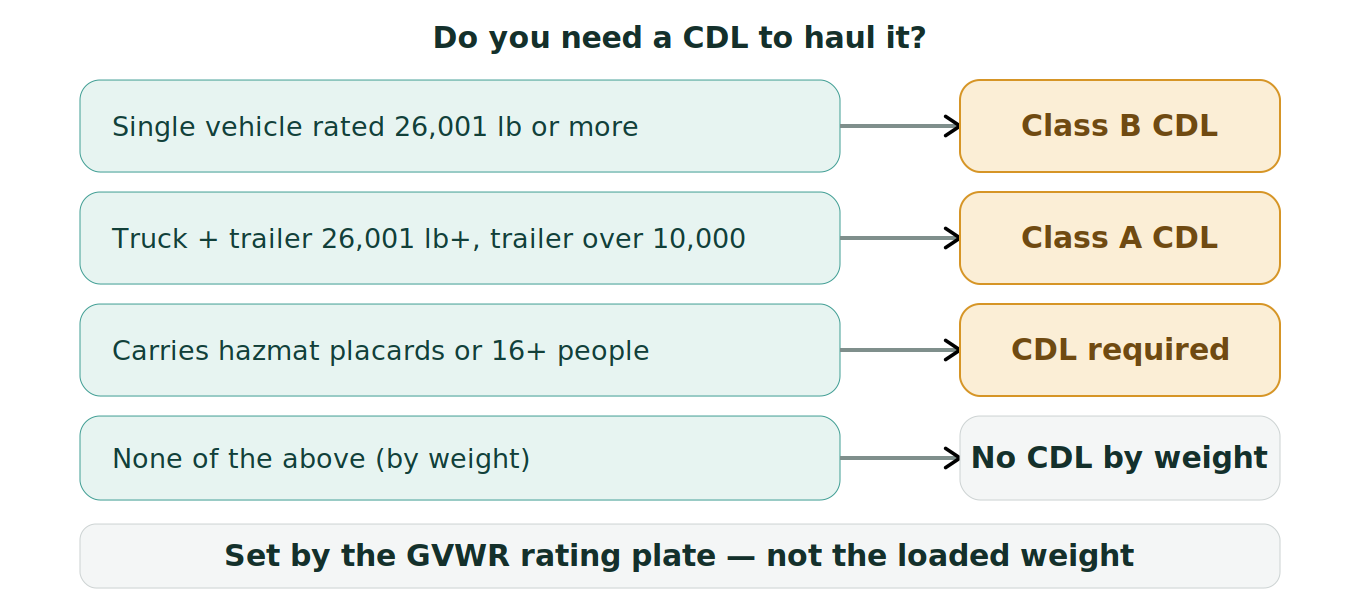
CDL requirements go by the GVWR/GCWR rating on the plate, not what the truck happens to weigh that day. Broadly: a Class A covers a combination rated at 26,001 lb or more where the towed unit is rated over 10,000 lb; a Class B covers a single vehicle rated at 26,001 lb or more. The rating plate decides it, so a lightly loaded rig can still require a CDL because of what it’s rated to carry.
Farm exemptions don’t cover the dealership
Customers may haul under farm exemptions (covered farm vehicles, ag operations). Those generally do not apply to a dealership moving equipment as commercial transport. Don’t assume the customer’s exemption logic applies to a dealership driver — it usually doesn’t.
Securement
Cargo securement rules are specific: the aggregate working load limit of the tiedowns must be at least 50% of the cargo weight, heavy equipment generally needs a minimum of four tiedowns, and any accessories or attachments that can move (a loader, a boom) are secured separately. Securement is a weakest-link system — a chain is only as strong as its lowest-rated component and its anchor points. Under-securing a machine is how it comes off in transit.
Oversize and overweight
Wide, tall, long, or heavy loads need permits — width over roughly 8’6″ typically requires an oversize permit, with rules on markings, escorts, and travel times that vary by state. Know before you roll, not at the scale.
Where it goes wrong
- Judging CDL need by loaded weight instead of the rating plate.
- Assuming a farm exemption covers dealership commercial hauling.
- Under-securing — too few tiedowns, too low aggregate WLL, loose attachments.
- Moving an oversize load without the permit.
(General information, not legal advice; follow your dealership’s policies and current regulations.)
Related
Slips, trips, and yard traffic · Delivery day · Shop and yard safety · OSHA essentials.