
What an Ag Dealership Actually Is
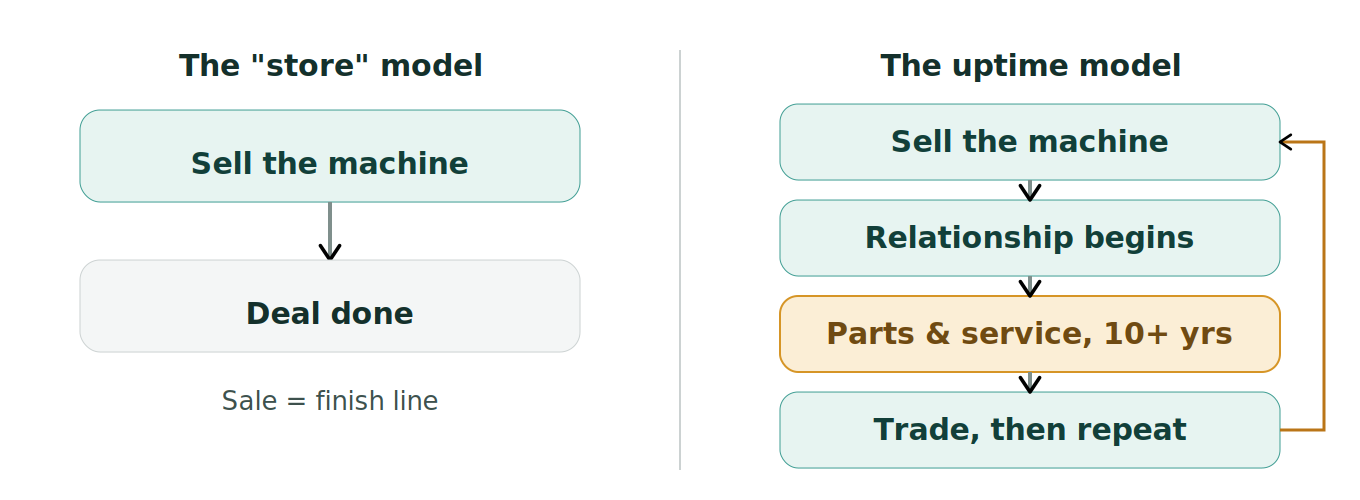
A dealership is an uptime business that uses equipment sales as the front door. The iron moves at thin margins; parts and service carry the place and decide whether it’s here in ten years. Once that’s the working model, the rest of how the building behaves — why the shop outranks the showroom, why a salesperson can give away a deal’s whole profit without noticing, why everyone snaps to at planting and harvest — stops looking arbitrary.
Where the money is
Whole goods move at thin, volatile margins — a new row-crop tractor in single-digit gross, a contested combine bid down to almost nothing against the dealer two counties over. Parts and service carry far healthier margins: parts gross commonly high-30s to low-40s percent, service labor sold well above the technician’s wage. The number that ties it together is absorption — the share of total fixed overhead (rent, salaries, insurance, floor-plan interest, all of it) covered by parts-and-service gross alone, before a machine is sold. Healthy runs about 75–85%. That’s why a dealership sells a combine at almost no gross and still wants the deal: the sale isn’t the payday, it’s the start of a 10-to-15-year stream of filters, wear parts, inspections, repairs, and eventually a trade.
Uptime is the product
Strip the iron away and the customer is buying one thing — confidence they won’t be sitting broken down in the middle of a 10-day planting window with rain coming. That’s why parts stocks the shelf, service runs extended hours in season, and the right sale is the machine that fits, not the biggest one. The enemy is downtime, not the dealer down the road: the competitor doesn’t cost the customer thousands an hour, a combine stopped at harvest does.
One machine, not four departments
To the customer there are no departments, only “the dealership,” and the handoffs between sales, parts, service, and the office are where most chaos starts. A Friday-delivery promise on a loader tractor lands on parts (mount kit and correct bucket in stock or on a hotshot by Thursday), service (pull a tech to mount it and run the PDI Thursday), and the office (finance and warranty paperwork ready to leave). Any weak link and the customer shows up to a machine that isn’t ready — and they’re not mad at the salesperson, they’re mad at the dealership.
The crop calendar runs everything
Two windows outweigh all others: planting in spring, harvest in fall. Inside them a down machine is an emergency, parts stays late, and service drives into a field at 9 p.m. Off-season — winter especially — is inspections, overhauls, selling, and ordering to get ahead of the rush. The winter inspection exists to prevent the harvest breakdown. Read the calendar and the dealership’s mood stops feeling random.
Where it goes wrong
- Treating the equipment sale as the finish line instead of the start of the annuity.
- Judging a deal on whole-goods gross alone and missing the parts-and-service value behind it.
- Making a customer promise that quietly obligates parts, service, or the office without checking.
- Treating the shop as secondary to the showroom.
- Being surprised the shop is buried in October.
Related
How a dealership makes money (absorption) · The departments and how they connect · The seasons of ag · Who is the customer.