
Diagnostic Software and Service Tools
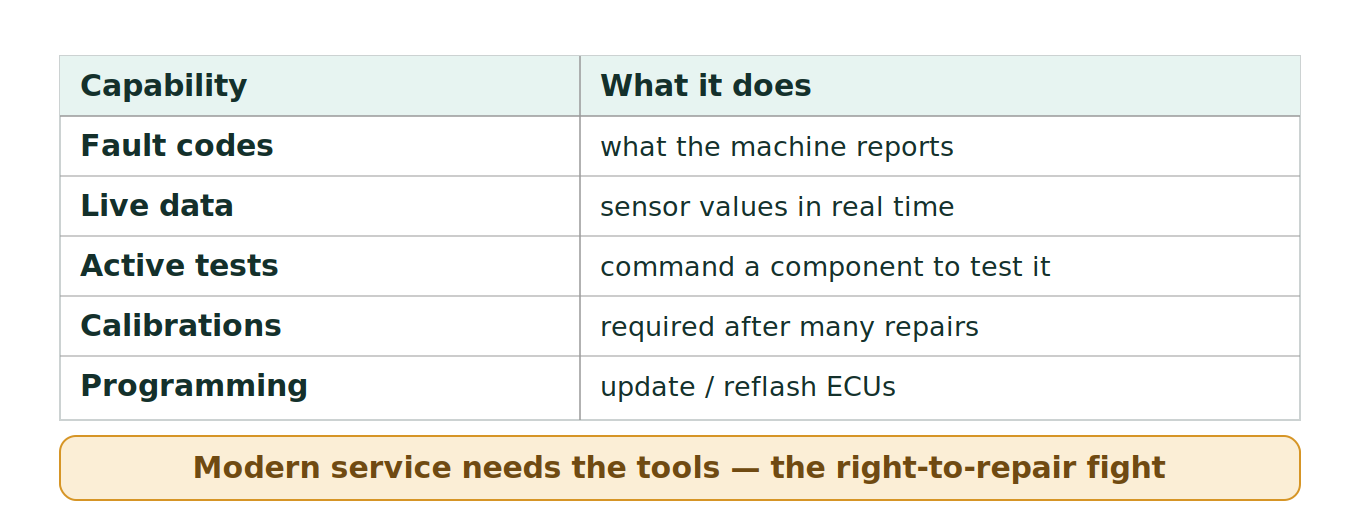
A current machine can’t be fully diagnosed or repaired without the OEM software and interface. The systems are run by controllers that the software talks to, and the capabilities it gives you — live data, active tests, calibrations, reprogramming — are where most modern diagnoses are actually resolved.
Live data is the fast path
Watching sensor values in real time as the machine runs is usually quicker to the fault than any static test. You catch the value that’s out of range, the sensor lagging or dropping out, the intermittent that a key-off check never shows. The skill is reading it in context: compare a suspect PID against the ones that should track with it and against physical reality — a coolant sensor reading 30°F on a warm engine is a sensor or wiring fault, not a cold engine.
Active tests and calibrations
Active (actuator) tests command a component to operate so you isolate whether it or its control circuit is at fault — cycle the solenoid, run the actuator, and watch. And many repairs aren’t finished until a calibration runs: a replaced sensor, a reset system, a new component often needs the software to calibrate it, or the machine throws codes or drops into a derate. Leaving a required calibration undone is a comeback you built in.
Programming and the access picture
Reprogramming and updating ECUs runs through the same software (covered next). Worth carrying: full tool and information access is the center of the right-to-repair fight in agriculture. Dealers hold the complete toolset; independents and farmers have had limited access, which is what the 2023 manufacturer–Farm Bureau MOUs, Colorado’s ag repair law, the FTC action, and the 2026 Deere settlement have been pushing to open. The full toolset is a genuine dealer advantage, and it’s worth understanding why customers feel strongly about it, because it comes up at the counter and in the field.
Where it goes wrong
- Diagnosing a modern machine “by feel” without connecting the software.
- Reading live data without comparing PIDs against each other and reality.
- Skipping a post-repair calibration and generating a comeback or derate.
- Not building fluency with the tool and staying slow on every modern job.
Related
Reading fault codes · Electronic controls and CAN bus · Software updates and reprogramming · Right-to-repair.