
Electronic Controls, Sensors, and CAN Bus
A current machine is a network: sensors feed data to several ECUs, the ECUs command actuators, and everything talks over a CAN bus (J1939 on the machine, ISOBUS 11783 out to implements). Diagnosis follows the architecture — a fault lives somewhere in that network, and knowing the structure tells you where to look and what a code is really pointing at.
The architecture
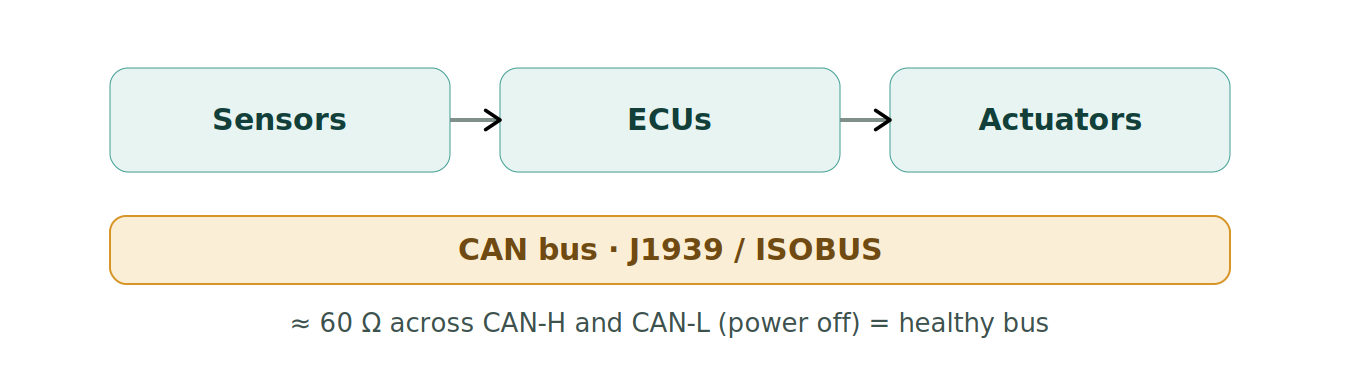
Sensors measure — pressure, temperature, speed, position — and report to the control modules. The ECUs decide and command actuators: solenoids, valves, motors. The bus is a twisted pair carrying CAN-High and CAN-Low that lets every module share data over a common set of wires, which is why one wheel-speed signal serves several systems at once. A machine carries many controllers, and a lot of “mechanical” behavior is actually a controller acting on a sensor input.
A code points at a node, not a part
A code names a circuit or component in the network — the starting point, not the answer. “Pressure sensor circuit” resolves to the sensor, its wiring or connector, its ground or power, or the actual pressure it’s honestly reporting. The architecture tells you the code marks a location to work, and the sensor it names is often the last thing that’s actually wrong.
Bus faults are wiring until proven otherwise
Communication faults present wide and confusing — several systems misbehaving, modules dropping off — and they’re almost always physical: a connector, a broken bus wire, a terminating resistor, or a power/ground problem, not a dead module. Check the bus itself before condemning anything expensive. With the system powered down, resistance across CAN-H and CAN-L should read about 60 ohms — the two 120-ohm terminating resistors in parallel. A reading near 120 means one terminator or a bus branch is open; a low or shorted reading points at the wiring. That one measurement rules a module in or out faster than any guess.
Where it goes wrong
- Replacing the sensor a code names before testing its wiring and ground.
- Condemning a module for a communication fault that’s really the bus wiring or a terminator.
- Skipping the 60-ohm bus check on a comms fault.
- Back-probing or jumping carelessly and damaging a controller.
Related
Reading fault codes · Diagnostic software and live data · Wiring diagrams · Precision ag hardware.