
Welding and Fabrication
Hot work in a shop full of fuel, hydraulic oil, tires, and sealed vessels, joining parts that sometimes hold a life. The skill is only half of it; the other half is what you clear before the arc, what metal you’re actually on, when a part gets replaced instead of welded, and keeping the current out of the electronics.
Clear the hazards first
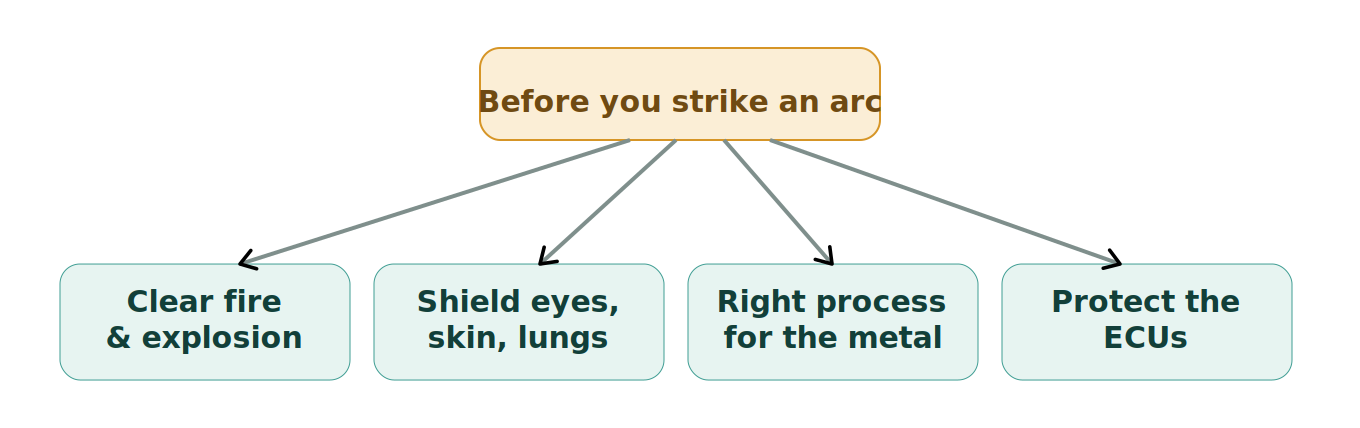
The danger is usually what’s around the weld, not the weld. Fuel tanks and lines, hydraulic systems, and any sealed or “empty” vessel full of vapor will explode — never weld on or near one without draining, venting, and knowing what was in it. Heat near a mounted, inflated tire can let it go with lethal force. Sparks and slag travel and start fires behind you, so clear combustibles, set a fire watch, and know where the sparks land. This is where welding kills people, and it’s entirely preventable.
Know the base metal
A weld holds or fails on matching the process, filler, heat, and prep to the material. Cast iron wants preheat, nickel filler, and slow cooling or it cracks. High-strength and HSLA steels lose their heat-treat if you dump heat into them — a repair that looks fine can fail under the load it was chosen for. Aluminum is its own process. Identifying the metal before you strike is the difference between a joint that carries and one that lets go later.
When not to weld
Some parts get replaced, not repaired. ROPS and FOPS structures are never welded, drilled, or modified — any alteration voids the certification and the structure may not protect the operator in a rollover. Safety-critical structural members, hitches, axle components, and many high-strength parts are the same call: a welded repair that doesn’t restore the original strength is a liability. Knowing when the answer is “this can’t be welded” is the judgment, not a limitation.
Protect the electronics
Welding current will destroy ECUs if it finds a path through them. Disconnect the battery (and isolate the alternator per the manual), and clamp the welding ground as close to the weld as possible so the return current never routes through a control module. Skipping this fries thousands of dollars of electronics on a machine you were trying to fix.
Where it goes wrong
- Welding on or near a fuel tank, hydraulic line, tire, or sealed vessel.
- Treating cast iron or high-strength steel like mild steel.
- Welding, drilling, or modifying a ROPS/FOPS.
- Repairing a safety-critical part that should be replaced.
- Welding on a machine without disconnecting and grounding at the weld.
Related
Fire prevention and hot work · PPE · Brakes, steering, and structural parts · Electronic controls and CAN bus.