
The Shop: Workflow and Culture
A service shop lives or dies on flow and culture, not just individual skill. The best tech in a shop with broken workflow still sits waiting on parts, a work order that doesn’t say what’s wrong, and a bay that’s blocked — and the shop’s real output is the whole system moving jobs cleanly, not any one person turning wrenches fast.
The flow of a job
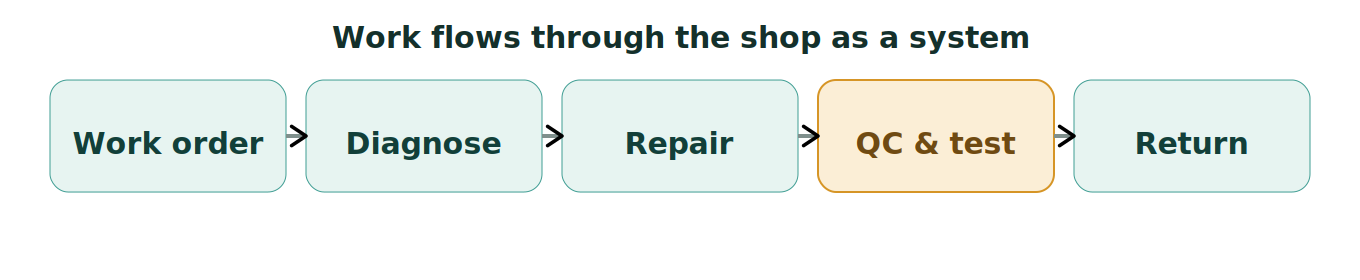
Write-up (a complete work order with the actual complaint), schedule and assign, diagnose, get parts, repair, quality-check, and return to the customer. Every handoff in that chain can stall the job: a vague write-up sends the tech guessing, a parts delay idles the bay, a skipped QC produces a comeback. The shop’s throughput is set by how clean those handoffs are, which is why workflow is a department skill, not a personal one.
Parts and service are one system
The shop is the parts department’s biggest customer, and a tech waiting on a part is idle labor plus a delayed customer. A shop that coordinates tightly with parts — staging parts for scheduled jobs, flagging needs early — keeps techs turning wrenches instead of standing at the counter. The friction between the bay and the counter is where shop productivity leaks.
Culture: safety, quality, and pulling together
A good shop culture is one where safety is normal, quality is expected (the work is done right, not just fast), and people help each other — the veteran who answers a question, the tech who flags a coworker’s missed step. That culture produces both fewer injuries and fewer comebacks, and it’s set by what the shop actually rewards, not what’s on the wall.
Where it goes wrong
- Treating shop output as individual speed instead of system flow.
- Vague write-ups that send techs guessing.
- Poor parts coordination idling techs at the counter.
- A culture that rewards fast over right and produces comebacks.
Related
Work orders and documentation · The departments and the handoffs · Shop productivity and efficiency · Quality control and comebacks.