
Work Orders and Documentation
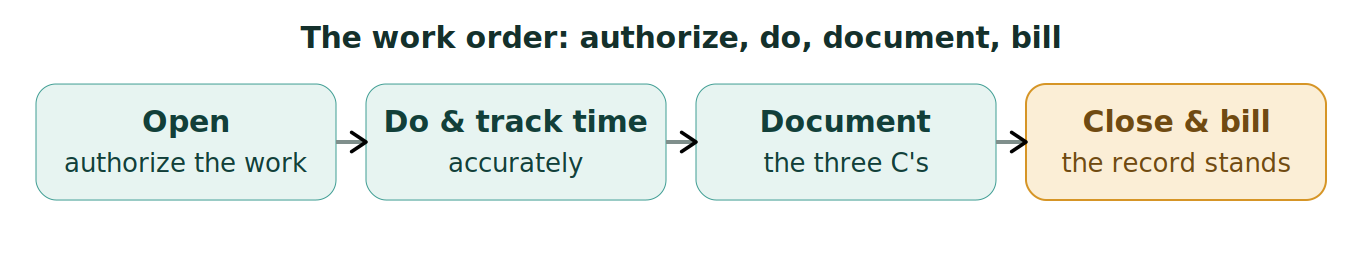
The work order is the job — how it gets diagnosed, billed, warranty-claimed, and remembered. Sloppy documentation is money lost: a claim denied, a job that can’t be billed for what it took, a history the next tech can’t use. The three C’s are the discipline that makes it hold.
The three C’s
Complaint — what the customer actually reported, in their words (the symptom, when it happens); Cause — what you found to be the root cause; Correction — what you did to fix it. Complete three C’s make the job diagnosable, billable, warranty-claimable, and useful to whoever sees this machine next. A work order that says “fixed it” documents nothing — it can’t support a warranty claim, can’t justify the bill, and tells the next tech nothing.
Document for the warranty claim
On warranty work the documentation is the money: the claim gets paid only if the three C’s, the failure, the parts, and the labor tell a consistent story that matches the OEM’s requirements. Vague or inconsistent documentation gets the claim denied or charged back, and then the dealership did the repair for free. Write the work order as if an auditor will read it, because on warranty jobs one will.
Track time honestly
Time on the job drives billing, flat-rate/efficiency measurement, and the shop’s numbers. Recording time honestly — the actual work against the flat-rate standard — is what makes the shop’s productivity and proficiency numbers mean anything and keeps billing fair to the customer and the dealership. Padding or fudging time corrupts the numbers the shop is managed by and can overcharge a customer.
Where it goes wrong
- Writing “fixed it” instead of complete three C’s.
- Documentation too vague or inconsistent to support a warranty claim.
- Recording the complaint as your interpretation instead of what the customer said.
- Tracking time dishonestly and corrupting the shop’s numbers.
Related
Filing warranty claims · Shop productivity and efficiency · The DMS · Quality control and comebacks.