
Tools, Torque, and Fasteners
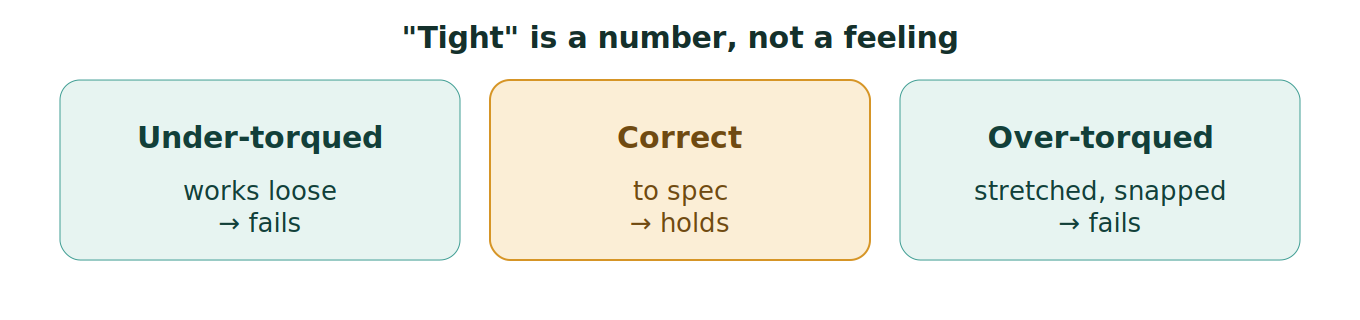
Tight is a number, not a feeling. The single most common cause of self-inflicted failures — leaks, stripped threads, broken bolts, warped parts, wheels coming loose — is fasteners tightened by feel instead of to spec, and the fix is a torque wrench and the value from the manual.
Torque to spec, in sequence
Every critical fastener has a torque spec, and often a sequence (head bolts, wheels, covers tightened in a pattern and sometimes in stages) so the part clamps evenly. Under-torque and it leaks, loosens, or lets go; over-torque and you stretch or snap the bolt, strip the threads, or warp the part. “Good and tight” is how a wheel comes off or a head gasket fails. Look up the spec and the sequence and use a calibrated torque wrench — this is where guessing costs a comeback or a catastrophe.
Torque-to-yield and one-time fasteners
Some fasteners (many head bolts, certain critical bolts) are torque-to-yield — tightened past their elastic limit by a torque-plus-angle procedure, and designed to be replaced, not reused. Reusing a stretched TTY bolt or skipping the angle step gives a clamp load that’s wrong even if the wrench “clicked.” Know which fasteners are one-time and follow the torque-angle procedure.
Grade, thread, and the right tool
Bolt grade matters — a low-grade bolt in a high-load spot fails — so replacements match grade and thread. And the right tool prevents damage: the correct-size wrench and six-point sockets on tight fasteners instead of rounding them off, the impact used where appropriate and the torque wrench where it’s required. A calibrated torque wrench that’s been abused as a breaker bar isn’t calibrated anymore.
Where it goes wrong
- Tightening critical fasteners by feel instead of to spec.
- Ignoring the tightening sequence and stages.
- Reusing torque-to-yield bolts or skipping the angle step.
- Wrong bolt grade, or the wrong tool rounding fasteners off.
Related
Reading service manuals · Measuring and precision tools · Shop equipment · Quality control and comebacks.