
Electrical: It’s Almost Always the Ground or the Connection
Modern ag equipment is a rolling network of electronics, and electrical faults intimidate techs into guessing or parts-swapping. But electrical diagnosis is methodical with a meter and a diagram, and in ag’s dirty, wet, vibrating world the fault is overwhelmingly a bad ground, a corroded connector, or a broken wire — not the expensive component everyone wants to replace.
Power, ground, connection
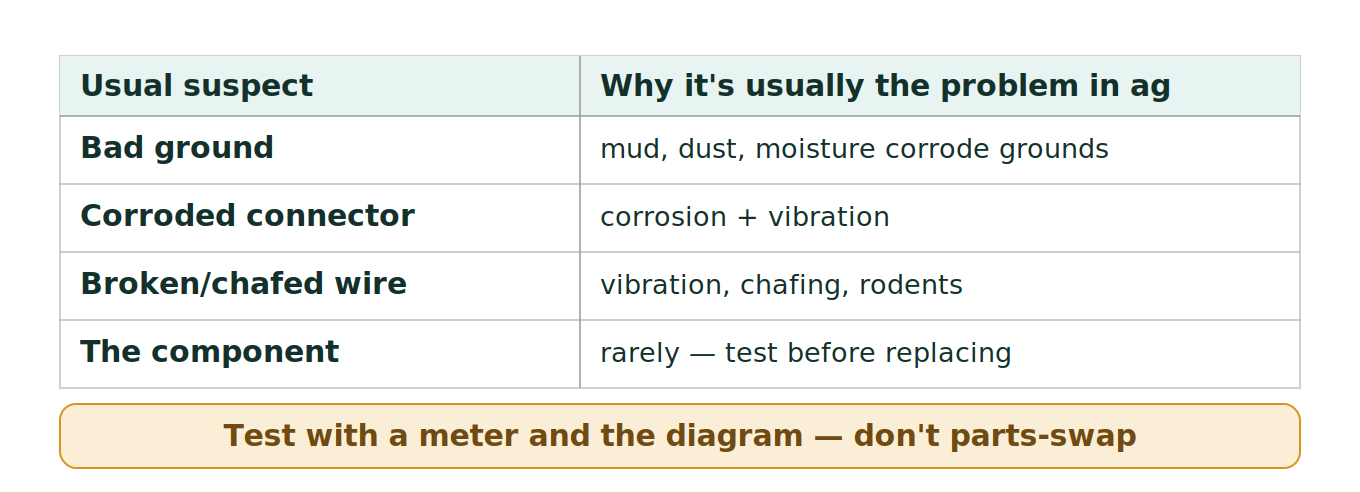
Almost every fault is a break in one of three things, and knowing that focuses the whole diagnosis. Power — is voltage reaching the component (fuse, upstream break, relay). Ground — is there a good ground (a corroded ground is one of the single most common and most overlooked causes of strange electrical behavior, and ag machines live in mud and moisture that destroy grounds). Connection — are the connectors clean and tight (corroded connectors and chafed wires, from vibration and rodents, are everywhere). When something misbehaves, these are the suspects, not usually the component.
Meter and diagram, not parts
Use the wiring diagram to understand the circuit — what connects to what, where the grounds and feeds are. Use a meter to test voltage at points, voltage drop across connections (which reveals corrosion resistance the eye misses), continuity, and ground integrity. Follow the circuit systematically from source toward load and narrow to the fault, instead of replacing parts and hoping. A voltage-drop test across a connector that reads high resistance finds a corroded connection nothing looked wrong with.
Protect the electronics
Improper electrical work destroys expensive ECUs — jumping the wrong points, careless probing, back-probing wrong, or reversing polarity can fry modules that cost a fortune. The methodical, diagram-guided approach finds the fault and keeps you from creating an expensive one. Work carefully around sensitive networked electronics.
Where it goes wrong
- Treating electrical faults as mysterious and guessing.
- Replacing the component while the fault is a ground or connector.
- Overlooking a corroded ground.
- Careless probing or jumping that damages ECUs.
Related
Reading service manuals and schematics · Batteries, charging, and starting · Diagnostic software and fault codes · Electronic controls and CAN bus.