
Hydraulics and Hydrostatics
Hydraulics run nearly everything on modern equipment, and the system rewards methodical diagnosis and punishes two things brutally: contamination, and casual respect for pressure. Most hydraulic problems are diagnosed with a gauge and a flow meter against the schematic — not by swapping the pump.
Diagnose pressure and flow, don’t swap the pump
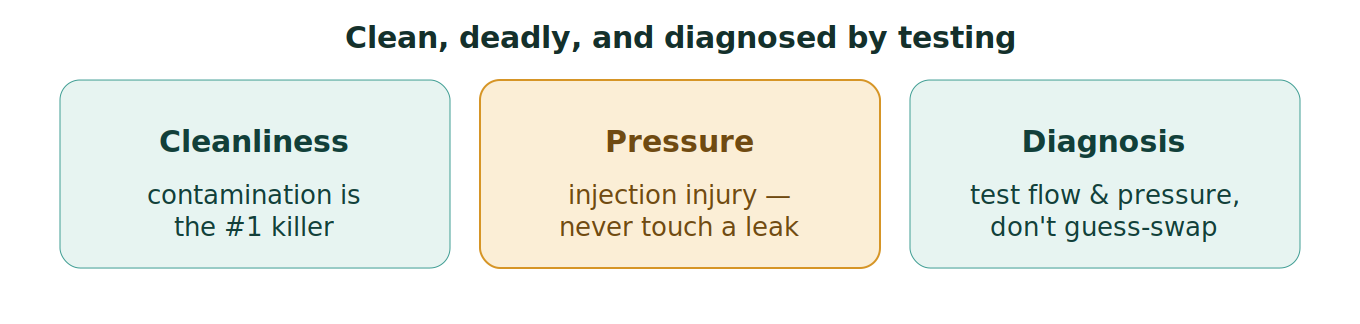
Hydraulic complaints — slow, weak, no function, overheating — are worked by measuring pressure and flow at points in the system against the schematic and spec. A pump gets blamed and replaced constantly when the fault is a relief valve, a worn component, a restriction, a control, or the wrong fluid. Pressure and flow readings isolate where the system falls short; the schematic says what it should be. Replacing an expensive pump on a guess is the classic hydraulic mistake.
Contamination and the right fluid
Hydraulic systems are precision, and contamination (dirt, water, wear debris) is a leading cause of failure — it wears pumps and valves and plugs the fine passages in control systems. Keep the system clean: clean connections before opening, the right filters changed on interval, and clean fluid. And the fluid has to be the exact spec — hydrostatic and modern hydraulic systems are sensitive, and the wrong fluid causes the very performance problems that look like mechanical failure.
Hydrostatics and stored energy
Hydrostatic drives (a pump driving a motor as the transmission) are diagnosed the same way — pressure, flow, and charge pressure against spec — and are complex and expensive, so diagnosis before disassembly matters. And the safety runs through all of it: high-pressure injection injury from a pinhole leak (find leaks with cardboard, never a hand), and stored energy in accumulators and raised implements after shutdown (relieve pressure, lower or block loads before working).
Where it goes wrong
- Replacing the pump instead of measuring pressure and flow.
- Letting contamination into the system, or using the wrong fluid.
- Tearing into an expensive hydrostatic unit before diagnosing it.
- Searching for a leak by hand, or working under a hydraulically held load.
Related
Hydraulic and stored energy hazards · Fluids, filters, and DEF · Transmissions · Reading service manuals and schematics.