
Field and Mobile Service
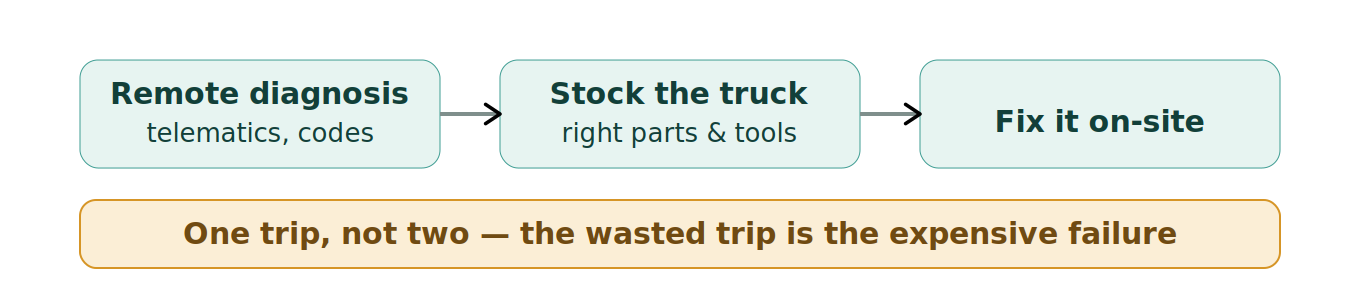
The service truck is a rolling shop, and the thing that decides whether a field call succeeds is what’s on it when it rolls. A wasted trip — the tech arrives without the part or the tool — costs travel time both ways plus a customer still down, which in season is the most expensive kind of failure.
Diagnose before you roll
The field call starts before the truck moves: get as much of the diagnosis as possible up front so the right parts and tools go out the first time. Telematics makes this real — reading the machine’s codes and data remotely can identify the likely fault and let the tech bring what’s needed instead of a guess. A good field dispatch confirms the machine, the symptom, and the probable parts before rolling, because the second trip for the part left on the shelf is pure waste.
Stock the truck and plan the route
The truck carries the common parts, fluids, and tools for the machines in the territory, restocked so it’s ready — a field tech who’s constantly missing common parts is a stocking problem, not a bad tech. Route field calls efficiently in a rural territory where drive time is expensive, grouping calls and pairing a field repair with nearby work. And field work carries its own safety: working on a machine in a field, on uneven ground, away from shop equipment, with the same lockout, stored-energy, and lifting discipline that the shop demands.
Field service is premium, and it’s the uptime promise
Getting a tech to a down machine in the field, fast, is exactly the uptime the dealership sells, and it’s priced accordingly (travel and premium). It’s also where loyalty is made — the customer whose combine got running in their field at harvest doesn’t shop their next machine. Deliver it well and it’s a differentiator and a profit center both.
Where it goes wrong
- Rolling without diagnosing first and making a wasted second trip.
- Not using telematics to bring the right parts.
- A truck stocked so poorly the tech constantly misses common parts.
- Dropping shop-level safety discipline because it’s a field.
Related
Running a field service program · Telematics hardware · Dispatching technicians · Harvest and seasonal readiness.