
How Dealers and Manufacturers Work Together
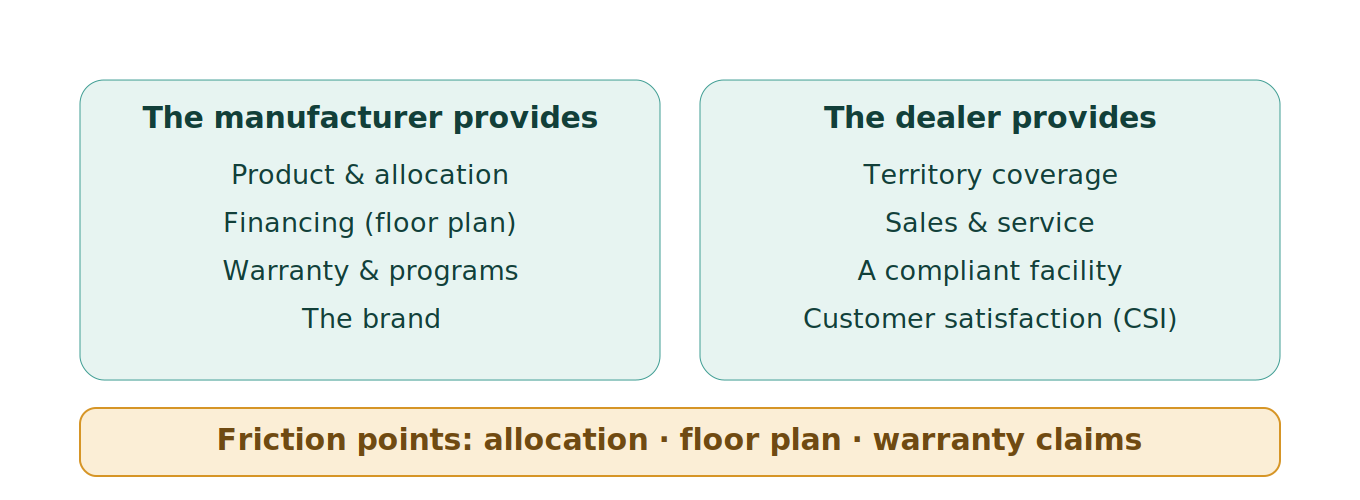
The OEM is the most powerful force on the dealership, and most of what it does is invisible until it isn’t — the machine you promised is “on allocation,” the aged unit is bleeding money, the sloppy warranty claim gets denied. Most “why did management do that” moments trace to one of five levers.
Allocation
The dealer doesn’t order whatever it wants whenever it wants. On popular machines the OEM allocates — how many of a model each dealer gets, usually off past sales and market share. When a model’s hot and supply is tight, allocation is the difference between having one to sell and telling a customer “spring.” Which is why promising a specific in-demand machine on a specific date, without checking allocation and the order bank, commits the dealership to something it may not deliver. Ordering ahead — building the order bank before the season — is how you keep allocation from leaving you empty when customers are ready.
Floor plan
Every new unit on the lot is usually financed, and the dealership pays interest every day it sits. That’s floor plan, and it’s the clock behind “we need to move that unit.” Interest quietly eats the eventual gross; curtailments pull principal paydowns as a unit ages; an aged unit — 14 months on the lot — can go from profit to loss purely on carrying cost before anyone negotiates. It’s why the used manager’s obsession with turn and aging is survival, not fussiness.
Warranty
Warranty work gets done, then claimed back from the OEM — and the OEM audits and enforces strictly. Documentation has to match: correct failure codes, a story that matches the parts, labor within allowed time. Sloppy claims get denied or charged back, and then the dealership did the repair for free; audits can claw money back months later. Warranty documentation is a discipline, not a formality — it’s where real money is won and lost.
Programs
The OEM constantly runs programs — subsidized low-rate financing, cash incentives, waivers, seasonal deferrals — often the thing that actually makes a deal work. They turn over frequently, hit hard at quarter- and year-end, and quietly decide which machines are easy to sell this month. Reaching for the program before discounting price is the move; quoting without knowing current programs is quoting in the dark.
Standards and CSI
The OEM holds dealers to standards (facility, training, tooling, technology) and measures customer satisfaction (CSI) through post-sale and post-service surveys. These affect the dealer’s standing and sometimes its programs and allocation, which is why a bad survey over something that felt small draws real attention from above.
Where it goes wrong
- Promising an allocated machine on a date without checking the order bank.
- Undercutting the urgency to move aged units because you don’t feel the floor-plan clock.
- Filing warranty documentation that gets denied or charged back.
- Quoting deals without knowing this period’s programs.
- Treating a customer survey as unimportant and tanking CSI.
Related
The industry at a glance · Whole-goods inventory and ordering · Filing warranty claims and passing audits · Cost of doing business.