
The Departments and the Handoffs
Every dealership has the same departments; the org chart shows them. What it doesn’t show is where the place runs smooth or lurches fire to fire — the handoffs between them. The botched delivery, the customer furious at everyone, the machine waiting on a $12 part all trace to a dropped handoff.
The internal customer
Departments are each other’s customers. Service is Parts’ biggest customer — the shop consumes parts all day, and a parts department that treats its own techs as an afterthought is starving its largest account. Sales is a customer of Service and Parts — every machine sold needs a PDI, setup, and often accessories installed. Everyone is a customer of the Office, which turns work into money (invoicing, financing, warranty registration, payroll) and depends on clean information from everyone. Treat the next department as a customer, not an obstacle, and the handoffs come clean — which is what a well-run dealership actually is.
One machine through the building
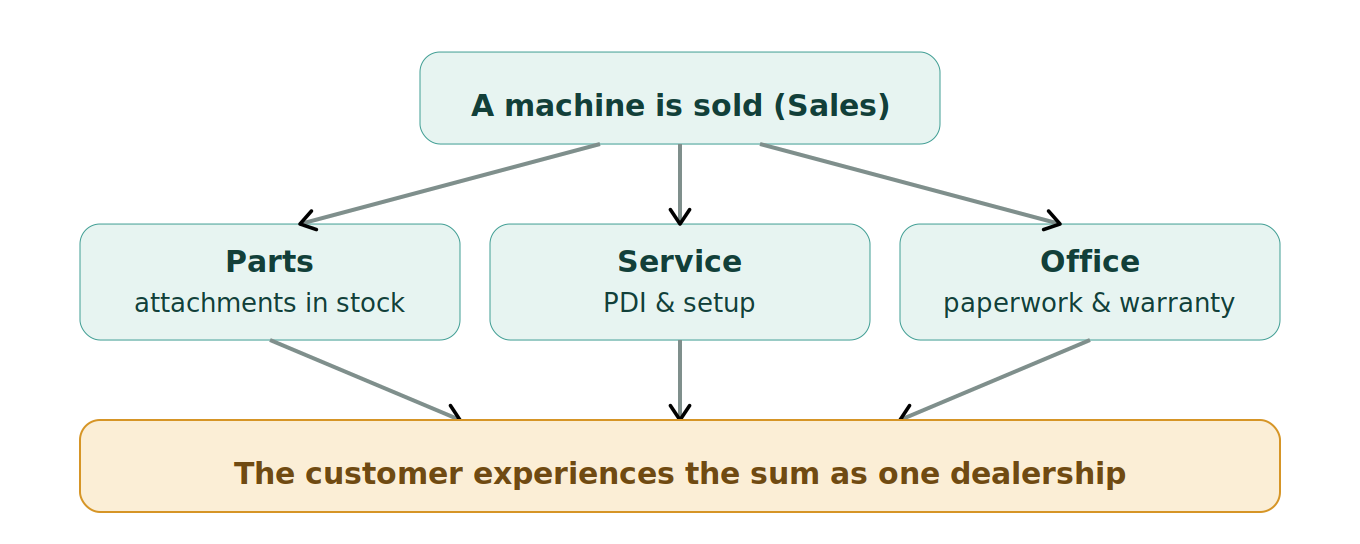
A customer buys a used skid steer Wednesday, wants it Saturday with pallet forks and a grapple. Sales writes the deal and makes commitments that obligate three departments. Parts must have the forks, grapple, coupler, and fittings in stock or inbound — and needs to know today, not Friday, if the grapple’s on backorder. Service must inspect, service, mount and test the attachments, and confirm the aux hydraulics — and can’t first hear about it Friday at 4. The Office must have financing and paperwork ready and register the warranty. Every one is a handoff; Saturday works only if each landed on time. Drop one and the customer blames the dealership — and often the salesperson they trusted.
The promises you don’t make without checking
Before committing a customer to any of these, check with the department that owns it: a delivery date (service shop load, parts availability); that a machine will do a specific job or pull a specific implement (specs, and service if it needs setup); a repair timeline (service owns it); a part’s stock or a specific price (parts owns it); anything about warranty coverage (confirm, don’t guess). A promise made without checking is made by someone who won’t have to keep it.
What prevents the chaos
The salesperson who’s a hero to the shop — realistic timelines, complete information, enough notice — becomes someone the shop wants to help, and their deliveries go smooth; the one who over-promises and dumps last-minute chaos gets slow-walked, and their customers pay for it. A parts stockout doesn’t stop one job — it idles a tech, delays a customer, backs up the schedule, and can blow a delivery. Communication is the job: good dealerships over-communicate anything that crosses between departments, and the chaos always traces to something someone didn’t pass along.
Where it goes wrong
- Treating another department as the enemy instead of a customer.
- Committing a delivery date without checking shop load and parts.
- Failing to pass along a change until it’s too late to react.
- Assuming “someone will handle it” instead of confirming the handoff landed.
- Blaming another department to the customer.
Related
How a dealership makes money · How a sale becomes a delivery · Closing and writing the deal · Scheduling and loading the shop.