
The Money Behind the Machine
You can’t sell equipment well to people whose business you don’t understand, and farm economics are unusual: income is lumpy, margins are thin and outside the farmer’s control, and buying is driven as much by cash flow and taxes as by the machine. That’s why timing and structure often beat sticker price.
Price-takers with thin, volatile margins
A farmer doesn’t set the price of what they sell — the market sets corn, beans, milk, and cattle, and those swing hard year to year. They control yield and costs, not price, so revenue is essentially yield × price × acres with price out of their hands, which makes margins thin and volatile. So the customer is intensely focused on the costs they can control, and equipment is one of the biggest — which is why cost per acre, cost per hour, and uptime value are the language that lands. You’re talking about the part of the business they actually steer.
Lumpy income drives when they buy
A row-crop farmer gets paid in a few big lumps — mostly when the crop sells after harvest — while expenses run all year, often bridged by an operating loan borrowed in spring and repaid after harvest.
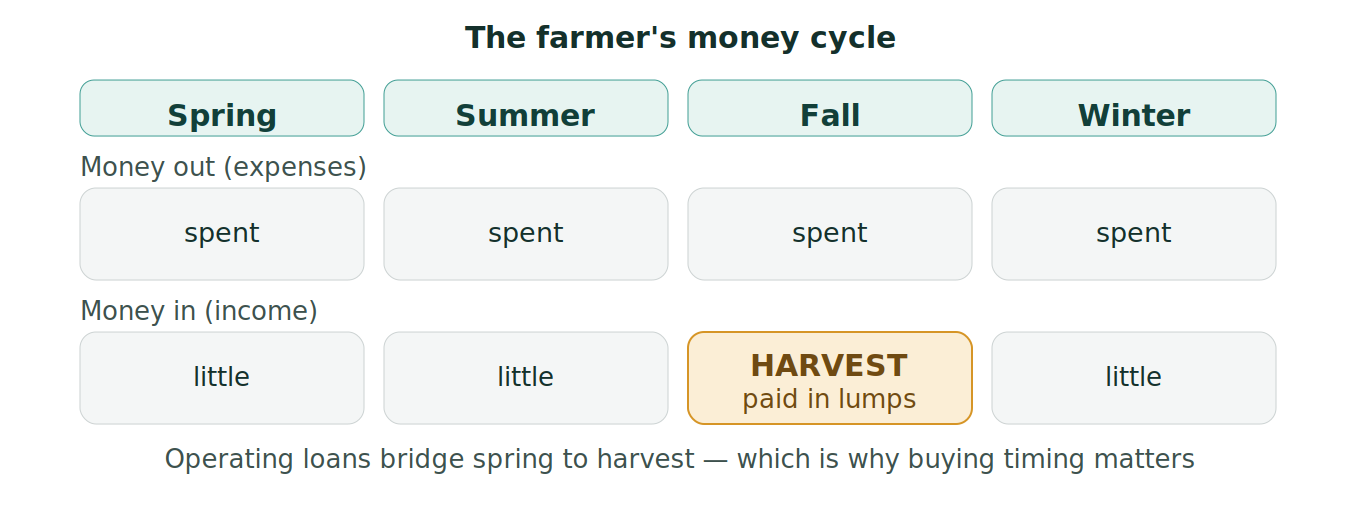
That one fact explains a lot of behavior. “No payments till after harvest” is a killer program because it matches money out to money in — not a discount, a payment that fits reality. A customer cash-poor in July isn’t broke, they’re between harvests; push for cash then and you lose, structure around the cycle and you win. And year-end tax buying is real: under Section 179 and bonus depreciation, a profitable farmer can write off equipment against income, so a strong year often produces a December scramble to buy before the tax year closes — sometimes the tax situation is the actual buying trigger.
How they evaluate a decision
Sophisticated customers compare cost of ownership against what the machine does, not sticker prices: cost per acre or hour over the machine’s life; uptime value (what a breakdown in the window would cost, which for a big operation dwarfs the price gap between two machines); capacity in the window; labor (a machine that does the work of two people or two passes has real value in a tight labor market); trade cycle and resale. Talk to those and you’re in the customer’s actual conversation; talk only price and you’ve reduced yourself to the cheapest number.
Where it goes wrong
- Assuming a lower price always wins when timing and structure matter more.
- Pushing a cash-strapped customer in midsummer instead of structuring around harvest.
- Missing the year-end tax-buying window and its December urgency.
- Selling on sticker price instead of cost per acre and uptime value.
- Ignoring commodity prices and the crop year, which set the customer’s whole mood about spending.
Related
Financing · Who is the customer · Consultative selling · The seasons of ag.
(General background for selling, not tax or financial advice; customers should consult their own advisors.)