
Lifting, Jacks, and Rigging
Ag equipment is heavy and awkwardly balanced, and the ways it hurts people are consistent: a load dropped off a jack, a component swinging off-center, a back blown out on a manual lift. The rules are simple and non-negotiable.
Jacks lift, stands hold
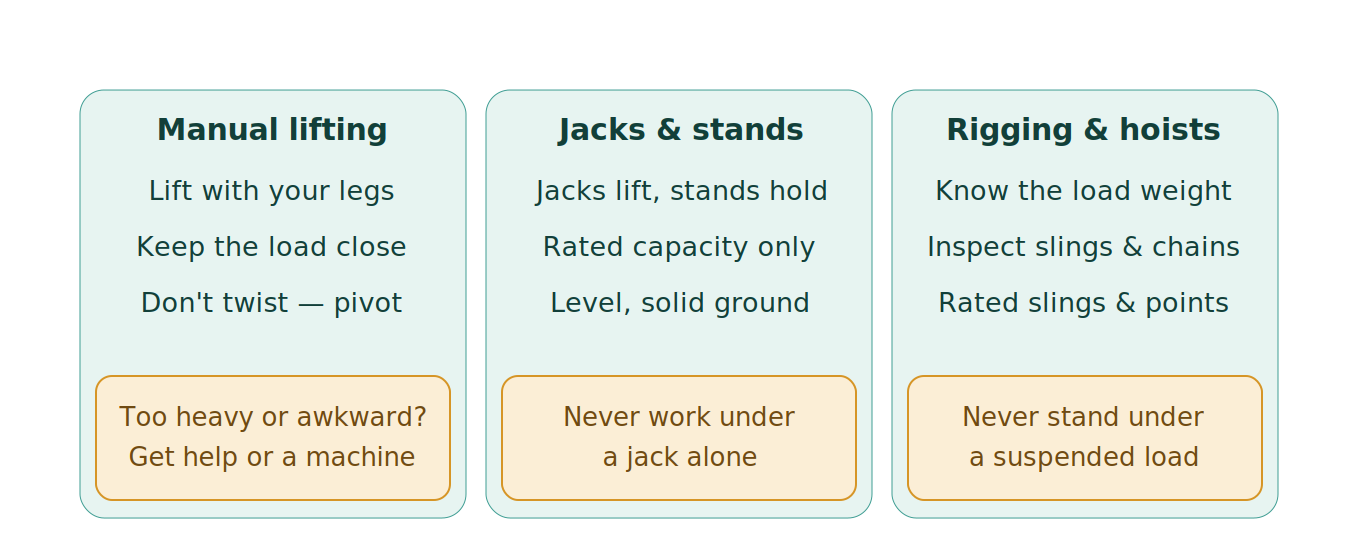
A jack raises a load; it does not hold one. Hydraulic jacks fail, leak down, and tip, and anyone under a load held only by a jack is betting their life on it. Once raised, the load goes onto jack stands or blocking rated for the weight before anyone goes under — the stands hold, the jack was just the elevator. On heavy ag equipment the loads are enormous and the consequences absolute.
Rigging: rated, and to the center of gravity
Lifting a heavy component with a crane or hoist is limited by the weakest link — the hoist, chains, straps, and lifting points all have to be rated, and the weakest one sets the safe limit. And the load has to rig to its center of gravity, or it swings, tips, or slips. Ag components are heavy and oddly balanced, so knowing where the weight centers and rigging it to lift level is what keeps a part from shifting and crushing someone. Sling angle matters: as a sling angle flattens, the tension in each leg climbs well above the load’s weight, so a wide, low-angle sling can be loaded far past its rating.
Lift with the machine, not your back
Use the equipment for heavy or awkward loads, team-lift what’s too much for one person, and keep loads close and legs under them on the lifts you do by hand. Most shop back injuries are one bad manual lift that a hoist or a second person would have prevented.
Where it goes wrong
- Working under a load on a jack alone.
- Exceeding a chain, strap, or lifting-point rating.
- Rigging a heavy component off its center of gravity, or ignoring sling angle.
- Manually lifting what should be a team or a hoist.
Related
Shop equipment: lifts, presses, jacks, cranes · Lockout/tagout · Tires and stored energy · Shop and yard safety.