
Fuel, Batteries, DEF, and Chemicals
The routine fluids kill people who get casual with them. Each has a specific way it hurts you, and a few of these are the kind of mistake you only make once.
Batteries
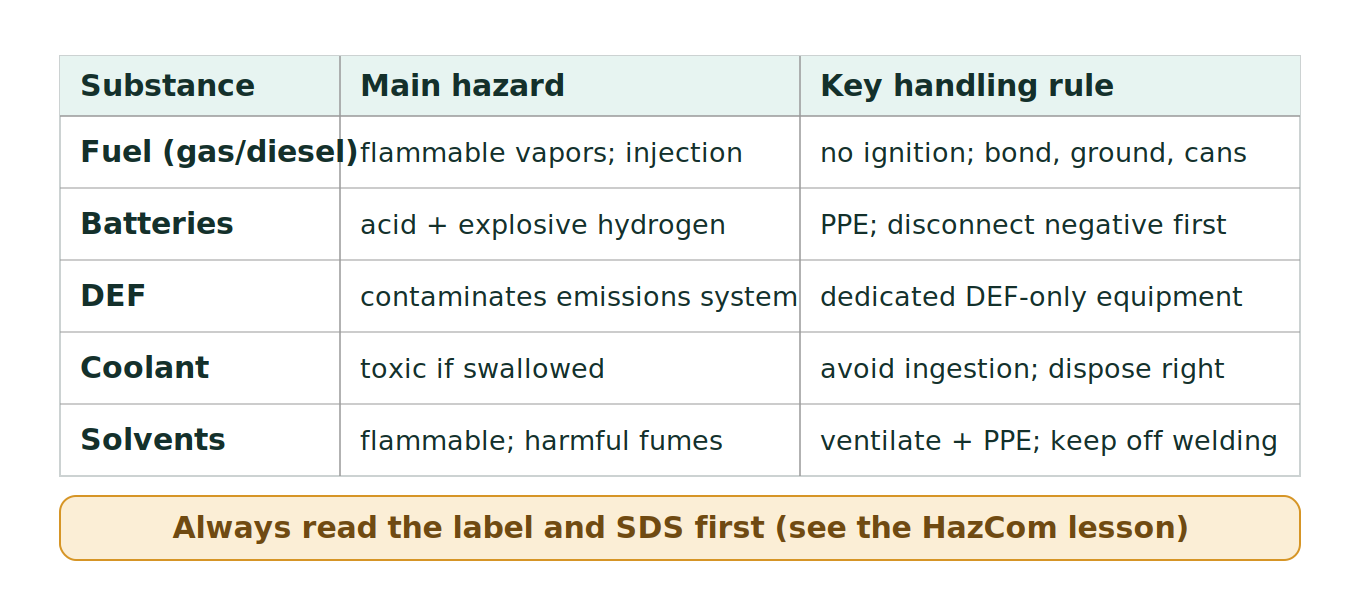
A working or charging battery vents explosive hydrogen, so a spark at the terminals can ignite it — no sparks, no smoking. Disconnect the negative terminal first and reconnect it last, so a wrench slip doesn’t short the battery through the frame. A battery can dump enormous current into a dropped tool across the terminals, welding it and exploding — keep tools clear. The acid is corrosive; protect eyes and skin.
Fuel
Fuel vapor, not just liquid, is what ignites, and it travels. No ignition sources, ground when transferring, ventilate, and treat “empty” tanks as full of explosive vapor — the welding lesson’s fatal-tank warning starts here.
The chlorinated-cleaner trap
Chlorinated brake and parts cleaners exposed to heat, flame, or welding arc can form phosgene, a deadly gas. Never use chlorinated cleaners near hot work or on parts about to be welded, and ventilate. This is a genuine “make it once” mistake — know which cleaners are chlorinated and keep them away from heat.
DEF
Diesel exhaust fluid must stay pure and separate — DEF in the diesel tank or diesel in the DEF tank ruins expensive systems, and contaminated DEF wrecks the SCR hardware. Dedicated, clean equipment; keep it away from other fluids.
Where it goes wrong
- Sparking at a battery, or disconnecting positive first.
- Treating an “empty” fuel tank as safe.
- Using chlorinated cleaner near welding or heat.
- Cross-contaminating DEF and diesel.
Related
Fluids, filters, and DEF · Batteries, charging, and starting · Welding and fabrication · Hazard communication.