
Receiving and Put-Away
Receiving is the front door of inventory accuracy — everything about counts, availability, and reorder math depends on parts being checked in correctly and put away in the right bin. It feels like grunt work and it’s where inventory integrity is made or lost.
Check it in against the order
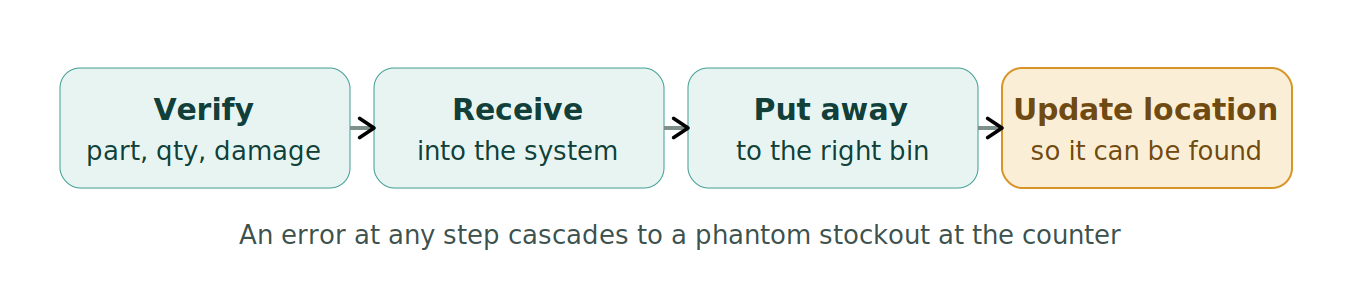
Verify what arrived against what was ordered and the packing slip: right parts, right quantities, no damage, nothing missing or substituted. Receiving a shipment blindly into the system means the counts now include parts that didn’t actually come, or miss a shortage — and every discrepancy not caught here surfaces later as a phantom stock number, a customer promised a part that isn’t there, or a vendor not credited for a shortage.
Receive promptly, then put away right
A part sitting in a received-but-not-shelved limbo is invisible: the system may not show it available, or shows it available but nobody can find it. Receive it into the system and get it to its bin promptly. Put-away is the accuracy-critical step — the part goes in its correct bin and the location is confirmed, because a part shelved in the wrong place is functionally lost until a count finds it, and it reads as a stockout while sitting ten feet away.
Special orders and the customer waiting
A special-order part a customer is waiting on gets flagged and the customer notified on arrival, not shelved into general stock where it disappears. The person who ordered it is watching for the call.
Where it goes wrong
- Receiving blindly without checking against the order and slip.
- Leaving received parts unshelved and invisible.
- Putting parts in the wrong bin and creating phantom stockouts.
- Losing a special order into general stock while the customer waits.
Related
Where parts live: bins and slotting · Point of sale in the DMS · Physical inventory and cycle counting · Purchasing and vendors.