
Stocking Levels: Min, Max, and Reorder
The core parts tension is fill rate versus turns — enough stock to serve the customer now, without so much that capital is frozen and shelves fill with obsolescence. Min/max and reorder points are how a department holds that balance instead of guessing.
Min/max and reorder points
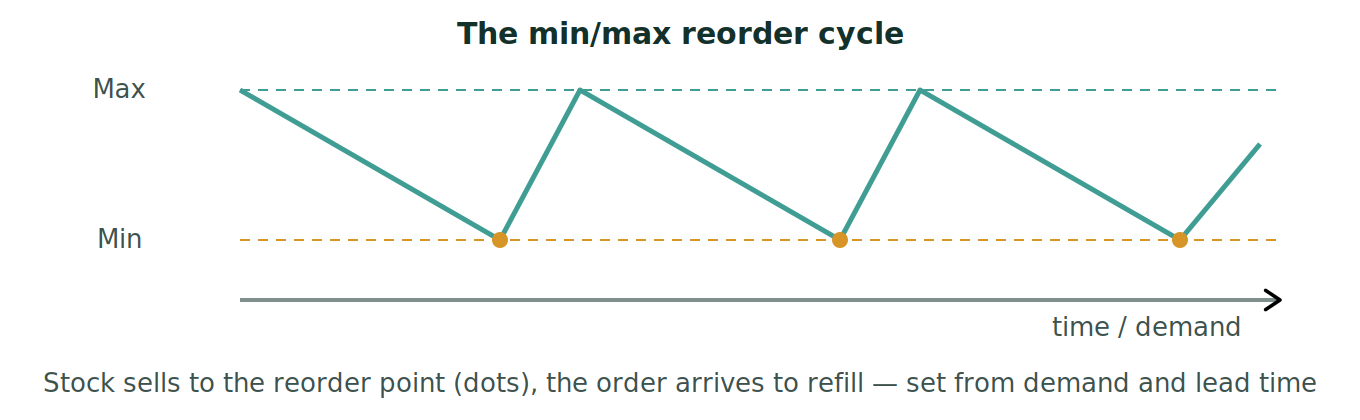
A minimum triggers a reorder before stockout; a maximum caps how much is carried; the reorder point and quantity restock the fast-mover automatically as it sells. These are set by demand — high-velocity parts carried deep, slow-movers carried thin or not stocked at all — and they only work if the data behind them is accurate, which is why every mis-keyed sale and mis-shelved part degrades the stocking math.
Fill rate vs turns is the whole balance
Fill rate (serving the customer from the shelf on the first try) pulls toward carrying more; turns (selling and refreshing inventory rather than freezing cash) pulls toward carrying less. Too much stock is capital tied up and obsolescence building; too little is lost sales and a customer sent to the competitor. The art is carrying the right parts deep and the wrong parts not at all — high fill on what moves, low investment in what doesn’t.
Stock the movers, don’t stock the dust
Velocity decides it: a part that sells constantly earns a deep, auto-reordered position; a part that sells twice a year is a special order, not stock — carrying it just freezes cash and ages toward obsolescence. Reviewing what actually moves and adjusting min/max keeps the investment working instead of collecting dust.
Where it goes wrong
- Setting stocking levels by feel instead of demand data.
- Chasing fill rate with overstock and killing turns.
- Stocking slow-movers that should be special orders.
- Trusting reorder math built on inaccurate counts.
Related
Inventory health: turns and fill rate · Point of sale in the DMS · Managing obsolescence and surplus · Forecasting parts demand.