
Service Manuals and Schematics
The manual is the difference between diagnosing and guessing. It holds the specs, the procedures, the torque values, the diagnostic trees, and the schematics that turn a complex machine into something you can work systematically — and the tech who works from it fixes it once, while the one who works from memory and feel produces comebacks.
The manual has the answer you’re about to guess
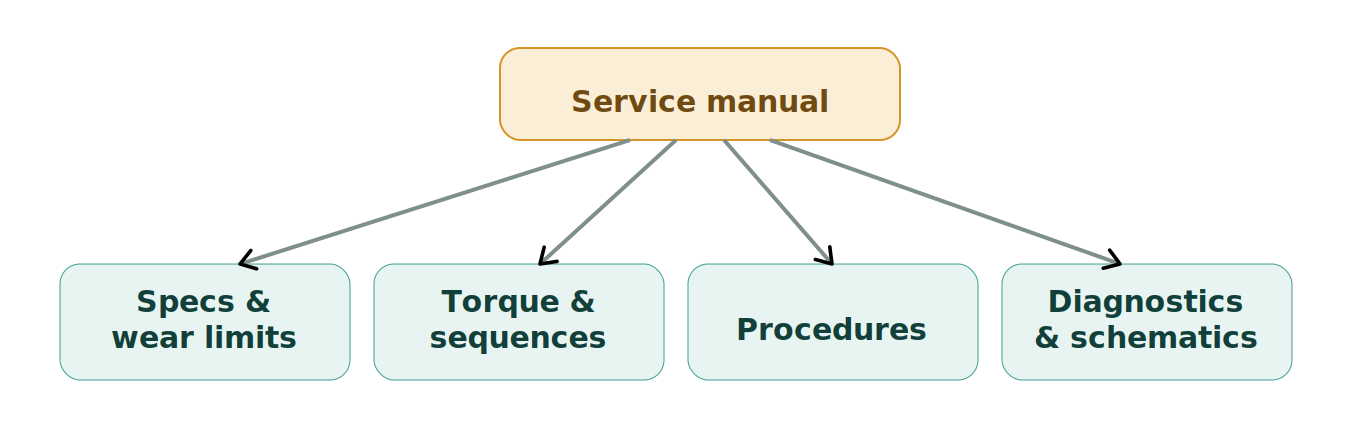
Specs and tolerances, step-by-step procedures, torque values and sequences, fluid types and capacities, wear limits, and diagnostic flowcharts that walk a symptom to its cause. The recurring failure is skipping it — working from how the last one went, or how a similar machine is built — on a machine that has a specific procedure, a specific spec, or a serial-break difference the manual would have flagged. Following the diagnostic tree instead of guessing is what separates finding the fault from swapping parts.
Read the schematics
Hydraulic, electrical, and CAN schematics show how the system is actually connected — what feeds what, where the grounds and pressure sources are, how the circuit should behave. You can’t systematically trace an electrical or hydraulic fault without the schematic; it’s the map you test against. Learning to read them is core to diagnosis, because a meter or a gauge only means something against the schematic that says what the reading should be.
Use the current, machine-specific version
Manuals are specific to model and serial range, and they get updated. Using the wrong model’s manual, an outdated version, or ignoring a serial-break note gives a spec or procedure that doesn’t apply to the machine in the bay. Confirm you’re in the right manual for the exact machine before you trust a number from it.
Where it goes wrong
- Working from memory instead of the procedure and spec.
- Skipping the diagnostic flowchart and guessing.
- Trying to trace a fault without reading the schematic.
- Using the wrong model or an outdated manual.
Related
Tools, torque, and fasteners · Reading fault codes · Electrical fundamentals and wiring diagrams · Diagnostic software and tools.