
Reading Fault Codes
A code identifies a circuit or symptom the ECU flagged — it narrows a complex machine to one system. It does not name the failed part, and the gap between “this circuit reports a fault” and “this component failed” is the whole diagnosis. Swapping the part a code names is the fastest way to bill a customer for a repair that doesn’t hold.
What the code actually gives you
On J1939 a fault is an SPN/FMI pair: the SPN (suspect parameter number) is what — which parameter or component — and the FMI (failure mode identifier) is how it failed: out of range high, out of range low, no signal, erratic, and so on. The FMI is the part techs skip and shouldn’t, because “circuit voltage high” versus “no signal” versus “data erratic” send you to different faults on the same SPN. Read both halves.
One code, several resolutions
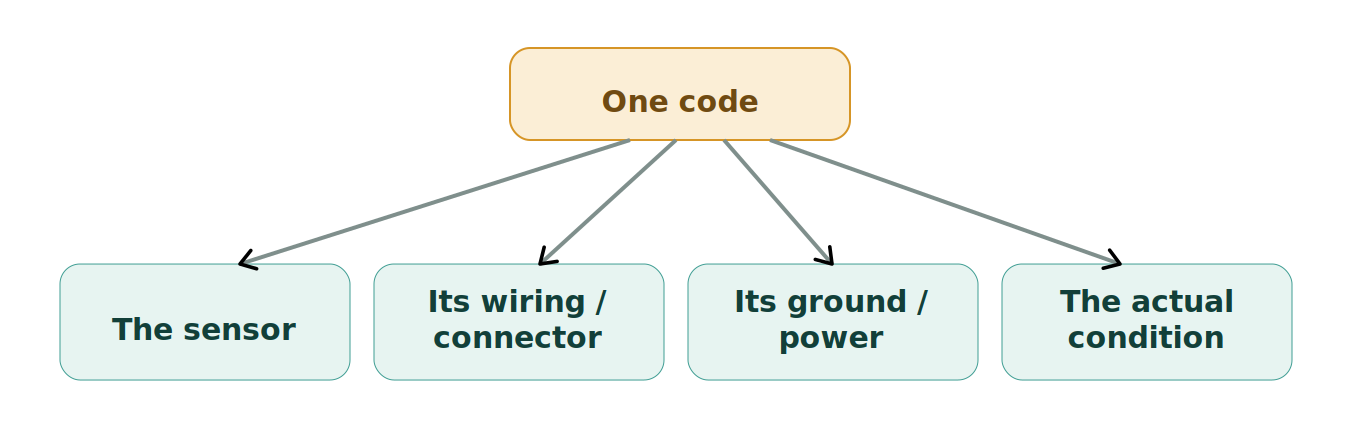
“Low oil pressure sensor circuit” resolves at least four ways: the sensor, its wiring or connector, its ground or power feed, or actual low oil pressure the sensor is reporting correctly. Treat a pressure or temperature code as a possibly real condition until you’ve confirmed otherwise — killing the messenger by replacing a sensor that’s honestly reading low pressure is how an engine goes out on the next shift.
Active, stored, freeze-frame
Work active codes first. A stored or historical code may be a one-time event long resolved, and chasing stale codes burns hours on a fault that isn’t present. Pull freeze-frame where the system logs it — the conditions at the moment of the fault (cold, under load, at a given rpm) often point straight at the cause.
The method
Read the code, pull its diagnostic procedure, then work it: wiring diagram, meter, live data, active tests, and the machine’s symptoms confirm what the code points at. Live data usually beats a static check — watch the suspect value live against the others and against reality. The procedure exists so you find the cause instead of the correlation.
Where it goes wrong
- Reading the SPN and ignoring the FMI.
- Replacing the named component before testing wiring, connector, and ground.
- Reacting to a stored code that isn’t active.
- Suppressing a code that’s honestly reporting a real condition.
- Skipping the manual’s procedure and going on the code alone.
Related
Electronic controls and CAN bus · Diagnostic software and live data · Wiring diagrams · Comebacks.