
Dealership Accounting Basics
Dealership accounting turns everything the departments do into the numbers that say whether the business made money — and it has features specific to this industry (departmental accounting, floor plan, absorption) that generic bookkeeping misses. Enough of the framework to understand how the money is tracked keeps the office and everyone reading the reports on the same page.
Departmental accounting
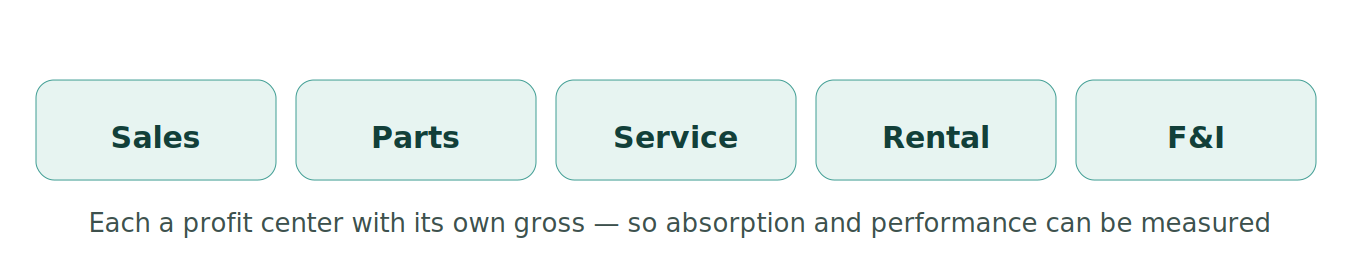
A dealership’s books are organized by department — sales/whole goods, parts, service, rental, F&I — because each is its own profit center with its own gross, and the total hides the truth the departments reveal. Departmental accounting is what lets absorption be measured (parts and service gross against fixed overhead), what shows thin whole-goods gross against healthy parts and service margins, and what tells management which department is carrying the business. The chart of accounts and the coding of every transaction to the right department are what make this possible — which is why correct coding at entry matters so much.
Gross, net, and the money model
The accounting reflects the money model: gross (revenue minus cost of goods) by department, then net (after all operating expenses — the cost of doing business), with the gap between them being the overhead that a big gross year can still lose money to. Absorption — parts and service gross covering fixed overhead — is the headline read on health. Understanding that the accounting exists to reveal these, not just to satisfy the tax filing, is what makes the numbers useful for running the business.
The industry-specific pieces
A few things are particular to dealership accounting and covered in their own lessons: floor-plan accounting (the financed inventory and its interest), inventory accounting (whole goods and parts as the largest assets), warranty and OEM receivables and coding, and the OEM’s required financial reporting format. These aren’t generic bookkeeping — they reflect how the dealership actually operates and how the OEM and lenders require it to report. Knowing the framework, even from outside the office, helps everyone understand why coding, inventory accuracy, and floor-plan discipline matter.
Where it goes wrong
- Treating the books as a total instead of departmental profit centers.
- Coding transactions to the wrong department and muddying the reports.
- Reading gross as profit and missing the overhead gap.
- Ignoring the industry-specific pieces — floor plan, inventory, OEM reporting.
Related
How a dealership makes money · Financial statements and schedules · Inventory and floor-plan accounting · Month-end close and reconciliations.