
Inventory and Floor-Plan Accounting
Inventory is usually the dealership’s largest asset, and most of it is financed through floor plan, so getting the inventory and floor-plan accounting right is central to the whole financial picture. Errors here misstate the biggest number on the balance sheet and can create real trouble at a flooring audit.
Inventory is the biggest asset
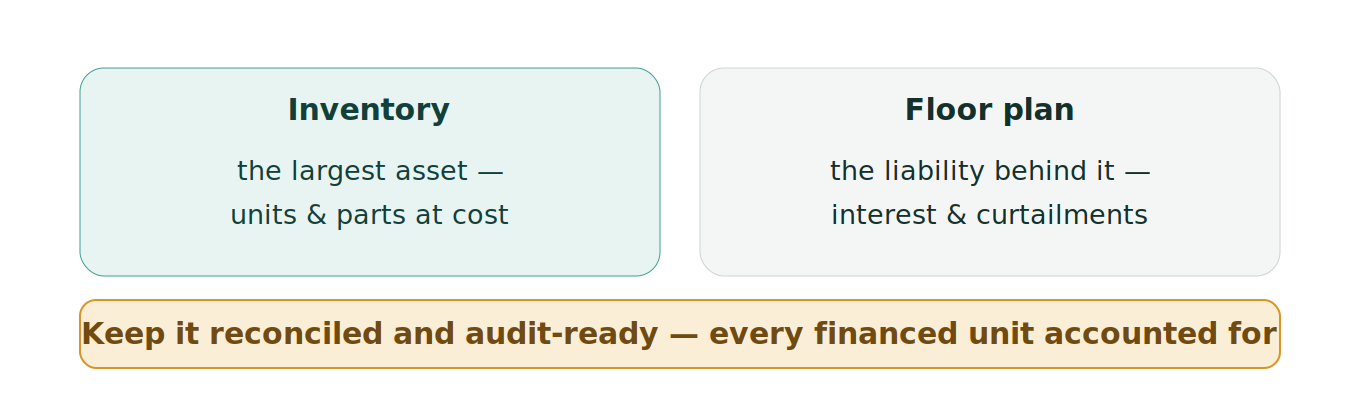
Whole goods and parts represent a large amount of capital tied up in stock, and that inventory has to be accurately valued and accounted for — the right units and parts, at the right cost, matching what’s physically there. Because it’s the largest asset, an inventory error (a unit not accounted for, wrong cost, a count that’s drifted, dead stock still carried at full value) misstates the balance sheet materially. This is why physical inventory, cycle counting, and accurate entry matter to the accounting, not just to operations — the counts are the asset value.
Floor plan is the financing behind it
Most new inventory is financed through floor plan, so each financed unit carries a corresponding liability and accrues interest every day it sits, with curtailments (required paydowns) as it ages. The accounting tracks the financed units, the floor-plan liability, the interest expense (a real overhead cost), and the curtailments — and it has to stay reconciled with the lender’s records. A unit sold but not paid off on the floor plan, or a curtailment missed, is exactly the kind of discrepancy that surfaces at an audit. The floor-plan accounting and the physical inventory have to agree with the flooring company.
Keep it reconciled and audit-ready
Because a flooring audit physically verifies that financed units are actually on the lot (or properly sold and paid off), the inventory and floor-plan records have to be accurate and current at all times — every financed unit accounted for, sold units paid off promptly, curtailments made. Keeping this reconciled continuously, rather than scrambling before an audit, is the discipline. A clean floor-plan reconciliation passes the audit; a sloppy one — sold units not paid off (“sold out of trust”), missing units, drifted records — is a serious problem with the lender.
Where it goes wrong
- Misvaluing inventory or carrying drifted counts and dead stock at full value.
- Not paying off floor plan promptly when a unit sells.
- Missing curtailments or letting floor-plan records drift from the lender’s.
- Scrambling before a flooring audit instead of staying reconciled.
Related
Dealership accounting basics · Floor plan financing and flooring audits · Whole-goods inventory · Physical inventory and cycle counting.