
Floor Plan Financing and Flooring Audits
Floor plan is the financing that lets a dealership stock inventory it couldn’t buy outright, and the flooring audit is the lender physically checking that the financed units are where they should be. Getting floor plan wrong — especially selling a unit and not paying it off — is one of the most serious financial problems a dealership can have.
How floor plan works
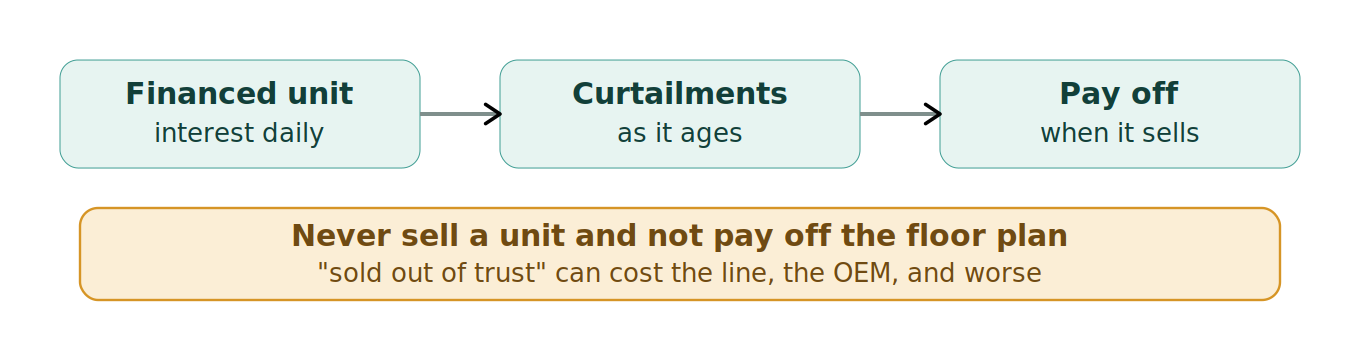
The dealership borrows against its inventory through a floor-plan line (from the OEM’s captive or a lender), so each financed unit is money owed, accruing interest every day it sits and subject to curtailments — required principal paydowns as the unit ages. When a unit sells, the dealership pays it off from the proceeds. Floor plan is what makes stocking a lot full of expensive machines possible, and it’s also the clock behind aging and turn: interest and curtailments make a unit that sits too long a money-loser before it’s even sold.
The cardinal sin: sold out of trust
The most serious floor-plan failure is selling a financed unit and not paying off the floor plan — using the sale proceeds elsewhere while still owing the lender for a unit that’s gone. This is “sold out of trust,” and it’s a grave breach: the lender financed a unit that no longer exists on the lot and hasn’t been paid for. It can trigger loss of the floor-plan line (which shuts down the dealership’s ability to stock inventory), legal consequences, and the end of the OEM relationship. Paying off floor plan promptly and completely when a unit sells is non-negotiable, and the discipline that prevents this is exactly what audits check.
The flooring audit
A flooring audit is the lender physically verifying its collateral — auditors come and check that every financed unit is either on the lot or properly sold and paid off, reconciling the physical inventory against the floor-plan records. A clean audit needs the records accurate and current at all times: every financed unit accounted for, sold units paid off immediately, curtailments made, no discrepancies. A dealership that stays continuously reconciled passes; one with sloppy records, missing units, or units sold and not paid off has a serious, sometimes existential, problem with its lender. Staying audit-ready every day beats scrambling when the auditor arrives unannounced.
Where it goes wrong
- Selling a unit and not paying off the floor plan (sold out of trust).
- Missing curtailments or letting interest quietly erode a unit’s gross.
- Floor-plan records drifting from the lender’s and physical inventory.
- Scrambling before an audit instead of staying continuously reconciled.
Related
Inventory and floor-plan accounting · How dealers and manufacturers work together · Whole-goods inventory · Internal controls.