
How a Dealership Makes Money
The money model, and the judgment that comes off it: why the shop outranks the showroom, why the parts manager holds margin on a filter, and how a salesperson gives away a deal’s whole profit without noticing.
Whole goods are thin; gross isn’t net
Whole-goods gross is thin and volatile — single-digit margin on a new tractor, a contested combine bid down to nearly nothing because everyone’s quoting the same machine. Gross is what’s left after the cost of the thing sold; net is what’s left after everything else — building, salaries, insurance, floor-plan interest, software. The gap is the cost of doing business, and it’s large enough that a dealership can post millions in gross and still lose money. “Big sales year” and “made money” are different statements.
Absorption
Absorption is the share of total fixed overhead covered by parts-and-service gross alone, before a machine is sold.
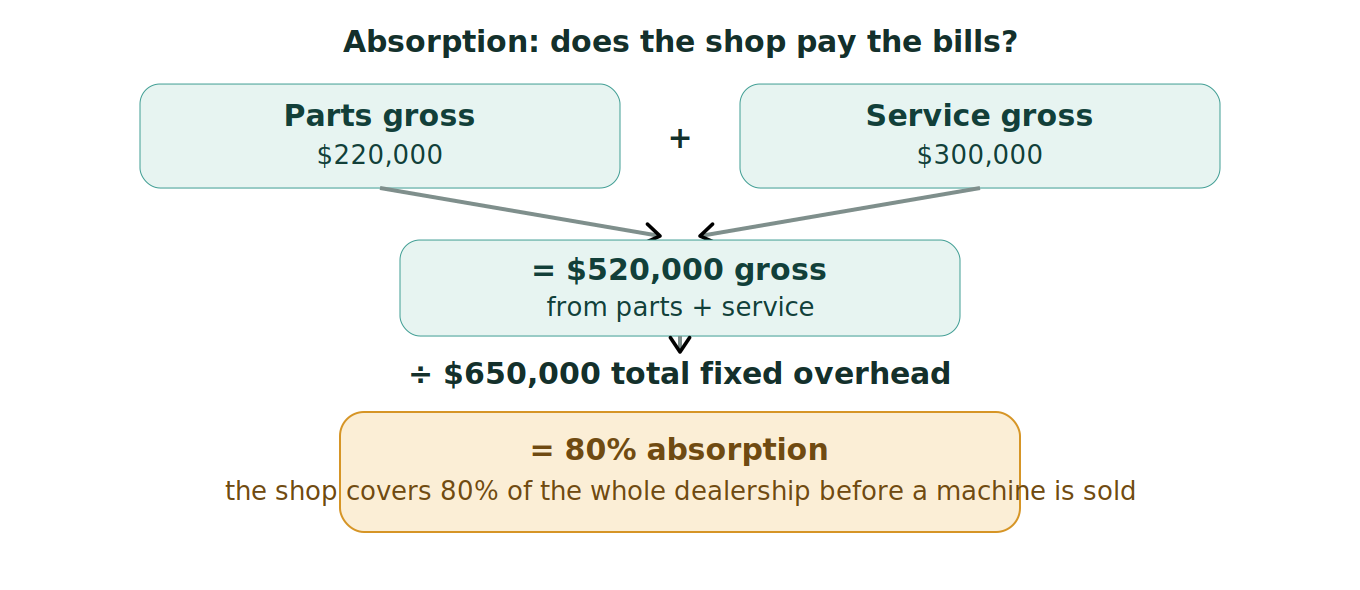
Read it as health: 80–85% is stable — whole-goods gross falls almost straight to the bottom line, and the dealership survives a bad equipment year. 100%+ is bulletproof — parts and service pay for everything and every dollar of equipment gross is profit. Down at 50% it’s fragile — it has to move a lot of iron at good margins just to break even. It’s also why the thin-gross machine sale is often the smart one: with overhead already carried by the shop, that combine’s thin gross drops to the bottom line and becomes a decade of parts and service.
Where the gross leaks
Whole-goods gross is thin, so it doesn’t take much to erase it. “I’ll throw in the first service” is high-margin service work — the exact gross that feeds absorption — given away. “We’ll cover freight and setup” is real cost eaten. “Knock off a couple grand” on a deal that had a couple grand of gross. Two or three of those and the machine sold at a loss and generated work for nothing. Protect gross by defending value, and if you give something, give what costs the dealership little — not the service work absorption runs on.
Why parts holds margin
Parts gross is a large share of absorption, so a point of parts margin across thousands of transactions a year is real money against that overhead. Holding the matrix on a low-cost fast-mover isn’t stubbornness — it’s protecting the number that keeps everyone employed.
Where it goes wrong
- Judging a deal by sticker size instead of gross.
- Giving away first service, freight, or setup — the profit — to close.
- Treating parts and service as support instead of the profit engine.
- Reading volume as profit.
- Writing off a low-margin sale that absorption makes smart.
Related
Cost of doing business · Financial statements · Reading the scoreboard (KPIs) · Objections and margin.