
Inventory Health: Turns and Fill Rate
A parts department’s health lives in the tension between two numbers, and reading either alone misleads. Fill rate is the customer’s experience; turns are the capital’s efficiency; and a department strong on one and blind to the other is either drowning in stock or losing sales.
The two numbers
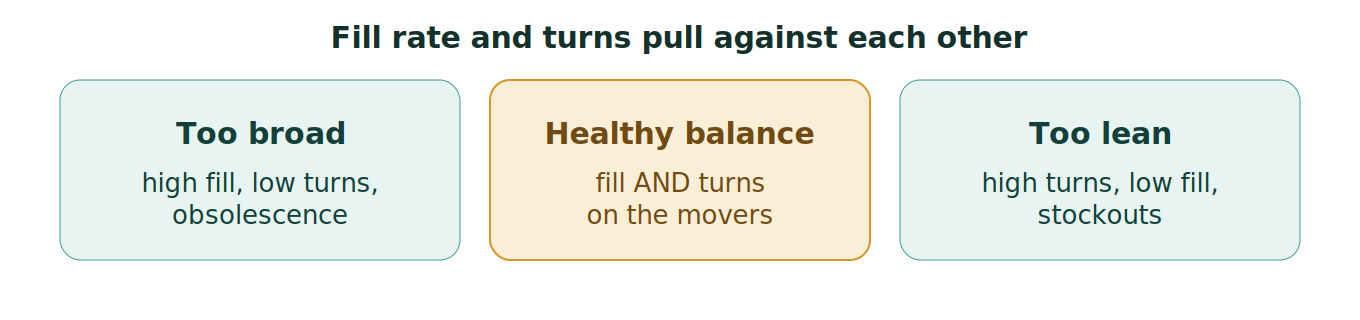
Fill rate is the share of demand served from the shelf on the first try — the customer-facing number, and low fill sends customers to the competitor. Turns is how many times a year the inventory sells and refreshes — the capital number, and low turns mean cash frozen in parts that sit and age toward obsolescence. They pull against each other: piling on stock lifts fill and kills turns; running lean lifts turns and drops fill.
Read them together, at the part level
A healthy department gets high fill and good turns not by picking a middle but by getting the mix right — carrying fast-movers deep (high fill on what customers actually need) and slow-movers thin or not at all (protecting turns). High fill with terrible turns is money frozen on shelves; great turns with poor fill is lost sales dressed up as efficiency. The health is in the mix, and the mix is a part-by-part decision driven by velocity.
Watch the trends and the tails
The numbers to watch: fill rate trend (is the customer being served), turns by category (where capital is stuck), and the aging tail (stock that hasn’t moved and is heading for obsolescence). Acting on the slow tail early — before it’s dead stock — is what keeps the whole department’s capital working.
Where it goes wrong
- Reading fill rate or turns alone and missing the other.
- Lifting fill with overstock and freezing capital.
- Running so lean that fill drops and customers leave.
- Ignoring the aging tail until it’s obsolescence.
Related
Inventory basics: min/max/reorder · Managing obsolescence and surplus · Tracking lost sales · Parts financials and margin.