
Obsolescence and Surplus
Every parts department accumulates stock that stops selling — a superseded part, a machine that left the area, an over-order that never moved. Left alone it’s dead capital and wasted shelf space that only gets worse, because an obsolete part rarely becomes sellable again by waiting.
Obsolescence builds quietly
Parts go obsolete as machines age out of the area, parts supersede, and demand shifts. The value doesn’t announce itself — it just sits, and every month it sits it ties up capital, occupies prime space, and drifts further from ever selling. The discipline is catching slow stock while it’s merely slow, not after it’s dead, because early action has options that late action doesn’t.
Use the manufacturer return program
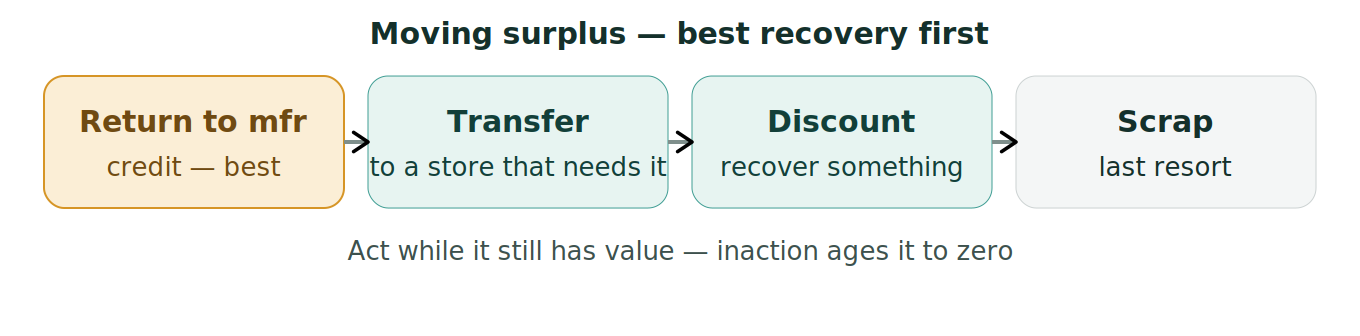
The most-missed recovery: manufacturers periodically offer stock return/adjustment programs letting a dealer return a percentage of eligible obsolete or slow stock for credit, often tied to stock-order volume. Managing to those programs — knowing the windows and the eligible-return percentage, and returning the right stock — recovers real money that otherwise dies on the shelf. A department that ignores the return program eats obsolescence it didn’t have to.
The other exits
Transfer slow stock to a store where it sells (the network), discount or promote to move it while it still has value, and write off what’s genuinely dead to clear the shelf and stop pretending it’s an asset. Taking the small loss to free space and capital beats carrying dead stock indefinitely.
Where it goes wrong
- Letting slow stock age into dead stock before acting.
- Missing the manufacturer’s stock-return window and eligible percentage.
- Hoarding obsolete parts as if they’ll sell someday.
- Never writing off genuinely dead stock and overstating inventory.
Related
Inventory health: turns and fill rate · Purchasing and vendors · Multi-location inventory sharing · Parts financials and margin.