
Physical Inventory and Cycle Counting
The system’s counts drift from reality no matter how careful the department is — a mis-shelved part, a sale rung wrong, a return not processed — and counting is how the record gets pulled back to the truth. The choice is between one painful annual reckoning and steady accuracy year-round.
Why counts drift
Every small error moves a number: a part put in the wrong bin, a sale under the wrong number, an unprocessed return, an untracked transfer. None is dramatic, and together they produce phantom stockouts (system says zero, part’s on the shelf), overstock (system says stocked, shelf’s empty), and reorder decisions made on numbers that lie. Counting exists because drift is inevitable, not because someone was careless.
Cycle counting beats the annual scramble
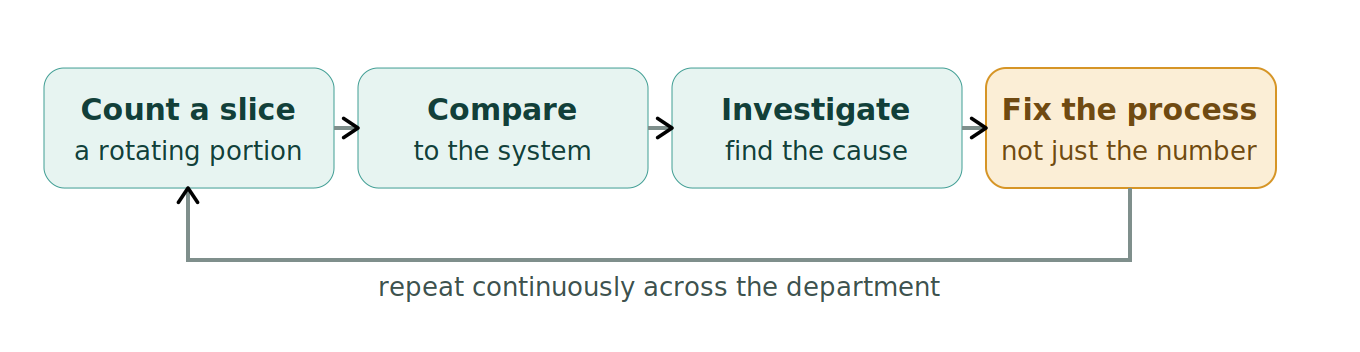
A full annual physical inventory is a big, disruptive, often shut-the-doors event. Cycle counting instead counts a slice of the inventory continuously — fast-movers and high-value parts more often — so discrepancies get found and fixed year-round while they’re small and traceable, accuracy stays high all the time, and there’s no massive annual disruption. It also surfaces the causes of drift (a recurring mis-shelving, a process gap) while they’re fresh enough to fix.
Count to find the cause, not just fix the number
The count’s value isn’t only correcting the number — it’s catching why it drifted, so the same error stops recurring. Adjusting a count without asking how it got wrong fixes today and leaves tomorrow’s drift in place.
Where it goes wrong
- Relying on one annual count and living with drift the rest of the year.
- Correcting counts without finding what caused the discrepancy.
- Ignoring the small errors that compound into phantom stockouts and overstock.
- Not counting fast-movers and high-value parts often enough.
Related
Receiving and put-away · Point of sale in the DMS · Where parts live: bins and slotting · The DMS.